
Harmony in Architecture as Medicine: Hospital de Sant Pau
Beauty and nature as active agents in healing, an innovative approach to building for human aliveness

In the heart of Barcelona, near the famous Sagrada Familia, sits the Hospital de la Santa Creu i Sant Pau. What made Sant Pau unique as a medical institution when it was conceived in 1902, by architect Domènech i Montaner, was that it was to be a container for treatment, with the container itself being an active part of treatment.
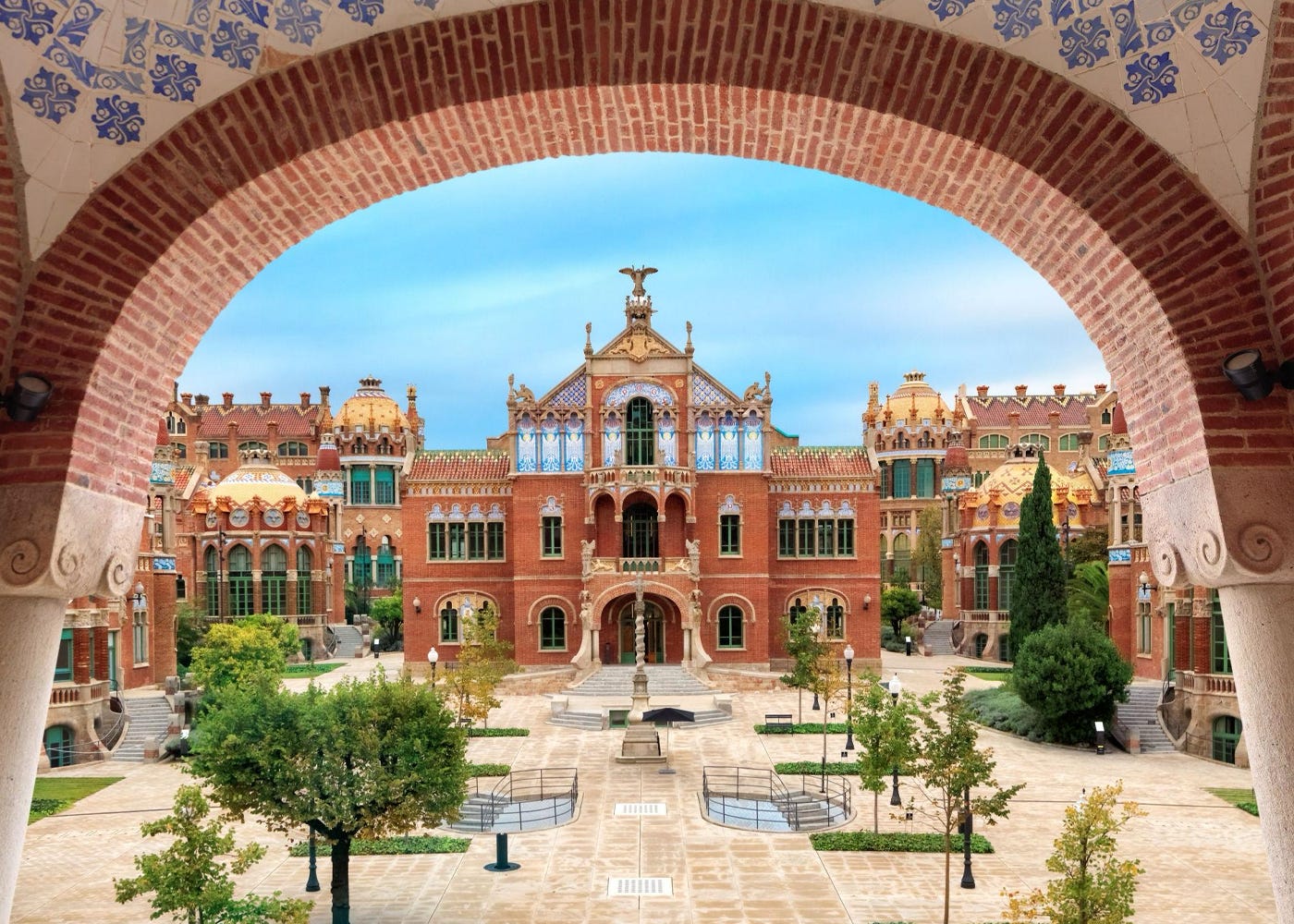
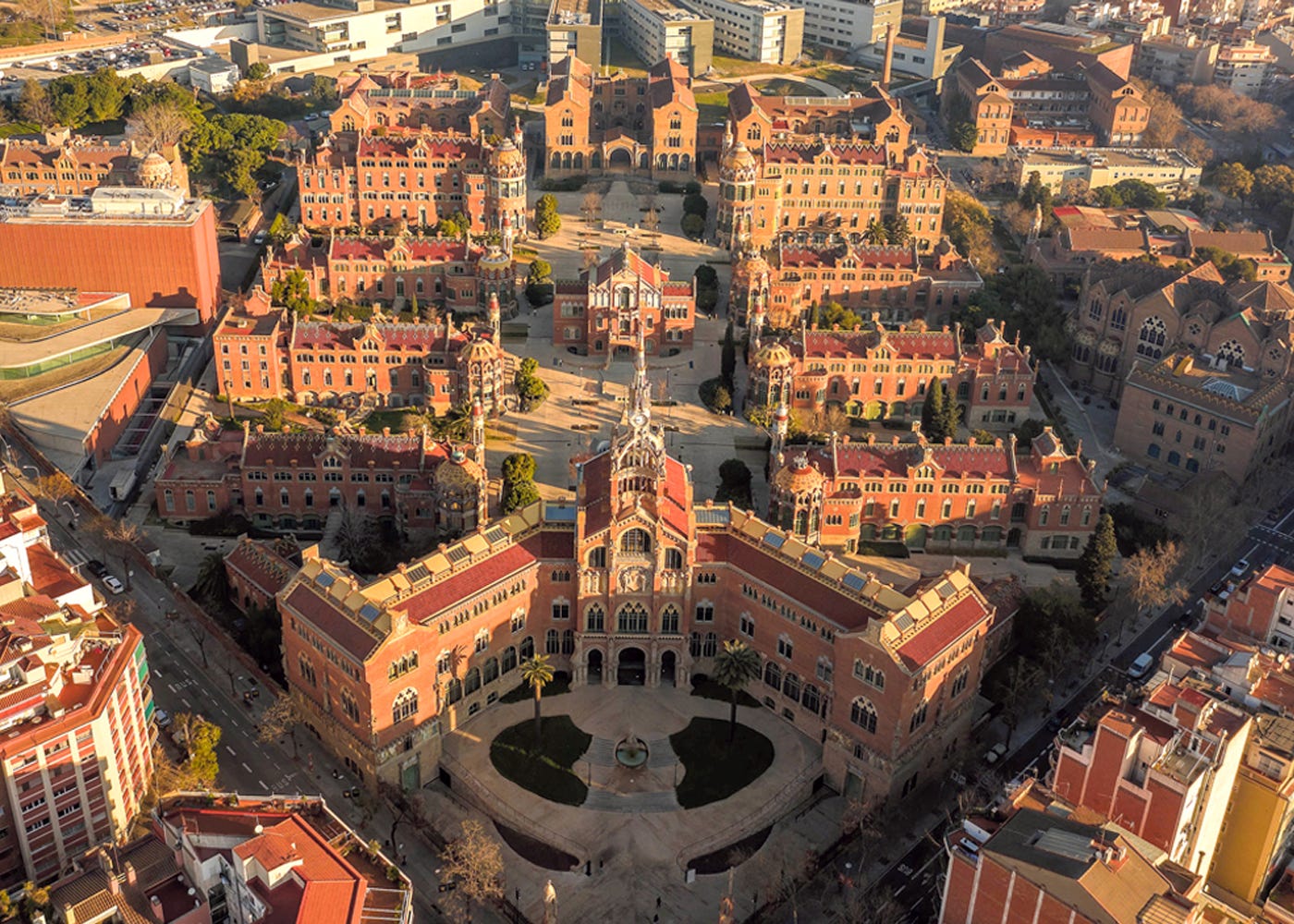
Instead of placing patients in one dense building, Domènech laid out a campus of separate pavilions, gardens, open air, sunlight, decorative surfaces, and underground service tunnels. By the time the hospital opened its doors in 1930, the team responsible had achieved a rare union of opposites: merging the sterile, rigorous demands of early 20th-century epidemiology with the psychological warmth and rich symbolism of Art Nouveau.
Domènech explicitly rejected the traditional city grid, rotating the entire hospital complex 45 degrees. This was not merely an aesthetic choice; it allowed the longitudinal facades of the pavilions to face perfectly north-south, maximising natural sunlight and capturing sea breezes to naturally ventilate the wards.
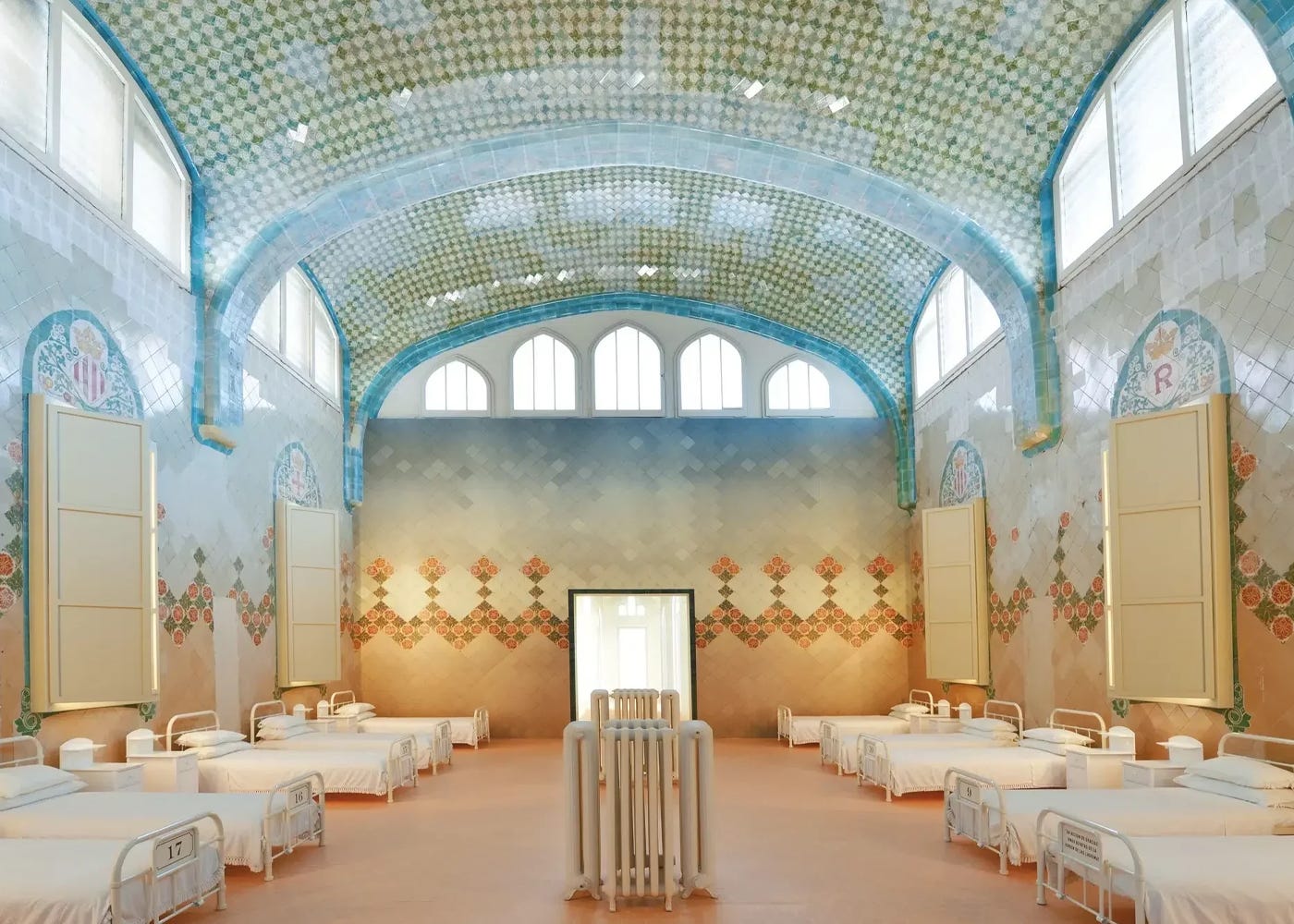
Inside the wards, the architect utilised structural steel to create lofty, vaulted ceilings that prevented the air from feeling stagnant. To minimize crevices where bacteria could hide, he relied heavily on curved surfaces. The interior walls were clad in glazed ceramic tiles featuring a sunrise-to-sky colour gradient, designed specifically to soothe the eye and lift the spirit.
The core ethos of Sant Pau was that beauty and nature are active agents in the healing process. Domènech i Montaner believed that a patient's physical recovery is deeply entangled with their psychological state, and the environment was designed to deliberately resonate with the nervous system to encourage physiological calm.
Mobile patients were encouraged to walk among the trees, breathing fresh air infused with medicinal plants. For bedridden patients, enormous windows were placed between the beds so they could always see the gardens, ensuring that the natural world remained a constant anchor.
And to keep the surface level perfectly serene, they built a mile-long network of underground tunnels connecting the pavilions. This ensured that the transport of laundry, medical supplies, and deceased patients never disturbed the tranquility of the gardens above.
Studies (most famously by Dr. Roger Ulrich in 1984) have proven that surgical patients in rooms with windows looking out at trees recover faster, have fewer negative nursing evaluations, and require statistically fewer strong pain medications than patients looking at brick walls1. In particular, exposure to high levels of natural daylight is clinically proven to reduce hospital stays2, improve patient sleep circadian rhythms3, and decrease rates of depression in both patients and healthcare staff 45.
Before designing Sant Pau, Domènech i Montaner spent years studying over 240 hospitals across Europe. One of his primary observations was the overcrowding that led to high mortality rates and designed Sant Pau to combat it. The hospital was planned with a generous 150 square meters (1,600 square feet) of space per patient, far exceeding even the 130 square meters recommended by the medical commission at the time.


The physical scale of modern medicine eventually outgrew the Art Nouveau complex. By 2009, the original brick pavilions could no longer accommodate heavy modern imaging machines and expanding surgical theatres. The clinical operations moved to a brand-new, highly advanced facility, situated at the northern edge of the campus. With the new hospital, the architects created a modern, blocky structure with a ceramic-louvered facade, while in fact attempting to translate some of Domènech i Montaner's philosophy into their 21st-century vernacular. The new building's layout is specifically designed around internal courtyards and massive windows so that almost every patient room and staff area is flooded with natural daylight. The ethos remained that a hospital should be filled with light, highly functional, and visually connected to the natural environment.
Ulrich, R. S. (1984). View Through a Window May Influence Recovery from Surgery. Science, 224, 420–421. https://doi.org/10.1126/science.6143402
Park, M. Y., Chai, C.-G., Lee, H.-K., Moon, H., & Noh, J. S. (2018). The Effects of Natural Daylight on Length of Hospital Stay. Environmental Health Insights, 12. https://doi.org/10.1177/1178630218812817
Scott, J., Langsrud, K., Goulding, I. R., & Kallestad, H. (2020). Let there be blue-depleted light: in-patient dark therapy, circadian rhythms and length of stay. BJPsych Advances, 27, 73–84. https://doi.org/10.1192/bja.2020.47
Volf, C., Aggestrup, A. S., Petersen, P. M., Dam-Hansen, C., Knorr, U., Petersen, E. E., Engstrøm, J., Jakobsen, J. C., Hansen, T. S., Madsen, H. Ø., Hageman, I., & Martiny, K. (2020). Dynamic LED-light versus static LED-light for depressed inpatients: study protocol for a randomised clinical study. BMJ Open, 10(1), e032233. https://doi.org/10.1136/bmjopen-2019-032233
Blume, C., Garbazza, C., & Spitschan, M. (2019). Effects of light on human circadian rhythms, sleep and mood. Somnologie, 23, 147–156. https://doi.org/10.1007/s11818-019-00215-x
I wish all hospitals are designed like that ❤️