
On The Duality of You and Me
How identity defines the world, and when presence, love, and awareness reopen it.

At some point in early childhood, people learn a separation. An “I” wakes up in consciousness and a divide is formed between “me” and “life.” For most people reading this, in fact, such a lived experience of life would be the continuous everyday norm. A few would also be comfortable in the recognition that the "I" is just a temporary island on the surface of a vast, unbroken ocean that is the mind. And perhaps some have truly experienced a prolonged sensation of love, where the separation between this and that disappears into a felt unity. However, in general, survival instinct comes calling again, and the thought experiment of wholeness swiftly reverts back to protecting my self (and my family) against the world. This is all happening in the invisible beauty that is the human mind.
The human brain has two primary ways for interacting with reality, and they are mutually exclusive. Like a seesaw, when one goes up, the other must go down: the default mode network (ego/thinking); and the task positive network (present/experiencing). The default mode network lights up when you are daydreaming, reflecting on the past, worrying about the future, or analysing yourself. It is heavily reliant on time and stories. While the task positive network lights up when your attention is fully demanded by the present moment.
Let me also briefly introduce you now to persona numero uno. Persona numero uno is an abstract construct, however if it didn’t exist, well, you wouldn’t exist. Persona is you. Okay, it’s not really you, but it’s what you think you are. So, arguably (we can’t say for sure), its main priority is to ensure survival, and to do so, it is constantly analysing the past and predicting the future… by thinking. Adjacent to this is a reality it knows viscerally well — humans have survived by cooperating in groups. To survive in a group, one must know where they stand, and in this light, a meaningful component of the persona numero uno’s objective is to monitor social status, manage reputation, and ensure belonging. The child wants to get what it wants (inner world stuff), however as it moves into the world it meets resistance. So numero uno gradually comes to cultivate an identity around who you are, blending a bit of who you really are with a bit of the outside world, in order for you to fit into society and prosper. It is always negotiating status, safety, and outcome, and there are ripple effects on all of our actions when that negotiating becomes the primary lens through which we meet reality (which we will come back to a bit later).
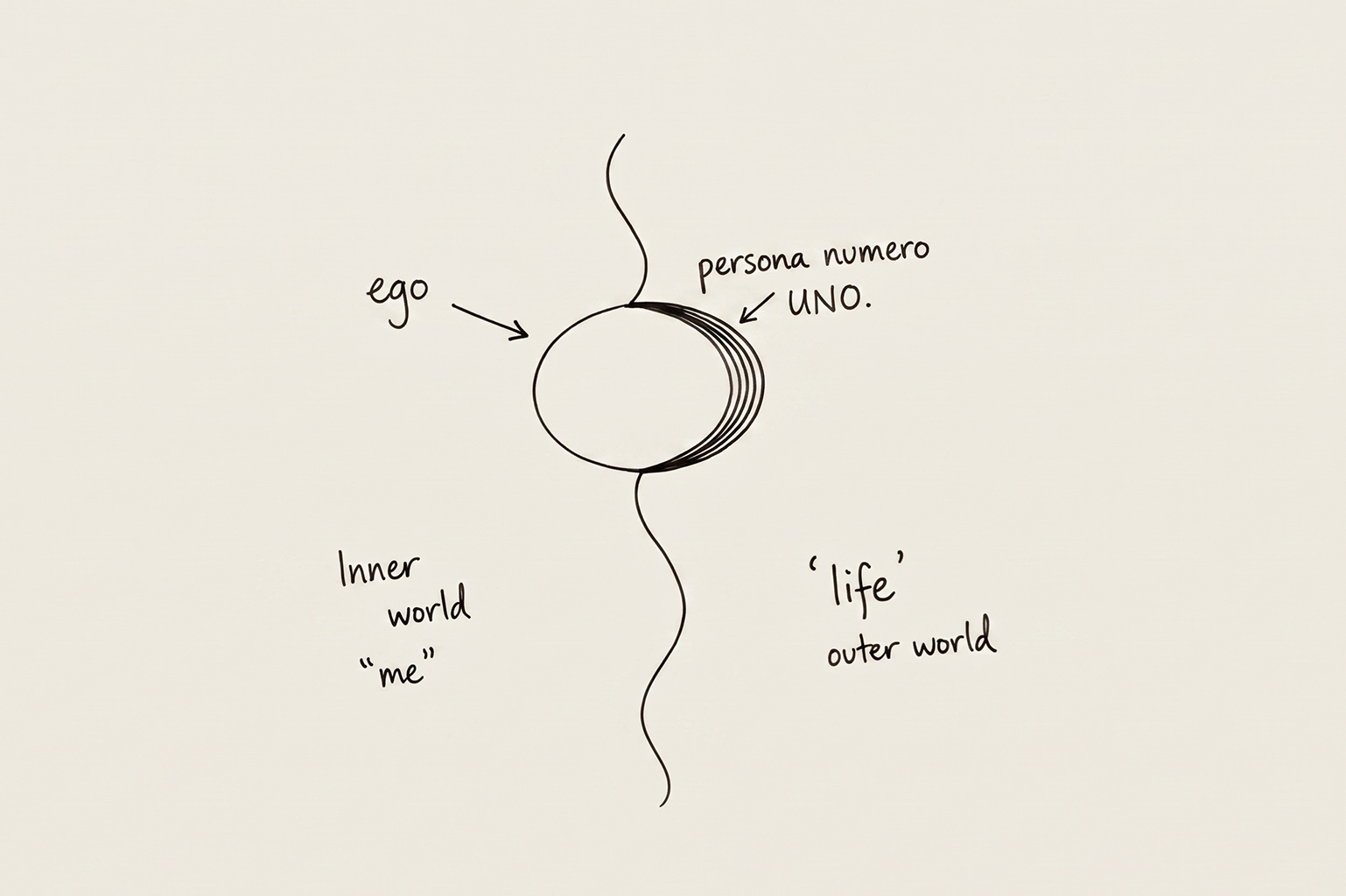
Persona numero uno’s place inside the mind exists on the surface of what we will call ego. The ego is the inner director of your consciousness (the localised “I” we discussed earlier), it exists on the edge between your inner consciousness and the outside world, and the persona is the costume that this director puts on to walk outside. The word persona literally comes from the Latin word for the theatrical masks worn by actors in ancient Rome.
Ego creates and cultivates the persona as a bridge between your inner world and the demands of society. It is inherently empty, with no substance of its own. Therefore, it cultivates this identity by attaching itself to both internal (subconscious) symbols and external aspects from life, and absorbing them into its sense of self. To build a specific identity, the ego must also reject anything that contradicts it. Identity is, in part, carved out through exclusion. And by telling a relentless story: “I am the artist, I am the wounded one, I am not enough, I am the caretaker, I am this, I am not that.”
This phrase “I am” is deceptively powerful. To say “I am,” you must simultaneously say “That over there is not me.” This creates the great split between Subject and Object. Without the friction of opposites (Self vs. Other, Inner vs. Outer, Subject vs. Object), there is no consciousness at all. Once the “I am” wakes up, the child is no longer simply living life as a passive, fused entity; they are now a separate observer experiencing life. This is the world of duality.
There is no real problem with any of this, by the way, despite what mumbo-jumbo spiritual traditions want to feed you. Issues start to unfold in part because of two factors that may occur: (i) in most people, ego and identity develops unconsciously; and (ii) in many cases it over-develops or under-develops. Because identity starts forming in childhood, where the sphere of awareness of the human is still quite small and the child is a vulnerable sponge to experience, it is largely happening in and of its own. That means that if a child, or young adult, is going through something consistently uncomfortable, or it does not feel safe in its direct environment (such as the space of its caregivers), the ego and identity will harden up fast (remember, it is, arguably, a self-protective survival mechanism). It is no surprise that the people who tend to “do well” in society, the big “achievers”, have a comparatively hardened ego, a rigid sense of self, and an incumbent ability to barrage their way elegantly through society. On the other side of the spectrum, over-bearing parents can lead to an inadequately developed identity, where the person has a harder time functioning effectively in society. In this case, a lot of the adaptability and development has happened within the protective bubble of the caregiver. This version of the ego is weak in will and has a hard time making things happen in life. A healthy, well-developed ego comes to understand itself as it is: a centre of consciousness within a vast, wide space of life and soul.
The atmosphere of life changes when awareness of soul is present. I stop relating to you as a bundle of attributes and start sensing the harmony of whatever energy is moving between us as the moment unfolds. I’m less concerned with what I can extract from the interaction and more aware of how life is meeting itself through two different forms. The attention shifts from outcomes to aliveness.
By choosing to exist in the vast open space of soul and life, I begin to notice patterns that feel meaningful in a way that bypasses my usual rational logic. Synchronicities that are almost certainly no accident. I can’t prove they are cosmically ordained, yet they arrive with the unmistakable texture of significance, like a quiet intelligence threading through events, inviting me into a larger coherence than my ego could imagine. The cause and effect nature of reality (that thing the ancients called karma) starts to really come to bear witness to our consciousness. We step out of the experience of duality, and start to reside in non-duality, observing life (and our own spirit) happening.
To reside in this space in everyday life is to quietly lighten the subject-object divide. Non-duality is the visceral recognition that beneath those useful distinctions, experience is one unfolding; you and I aren’t the same person, but the sense of hard separation softens, and life starts feeling like something happening in and as us, right here. Without the past and the future, the ego cannot exist. It requires a chronological narrative to maintain its shape, whereas the soul— or non-dual awareness — requires no narrative at all, because it is the pure, unmediated experience of the present.
The practice is not to abolish identity, but to stay awake inside it, and aware of the broader landscape. So that identity remains a tool and not a tyrant, something you can inhabit when it helps and release when it hardens.
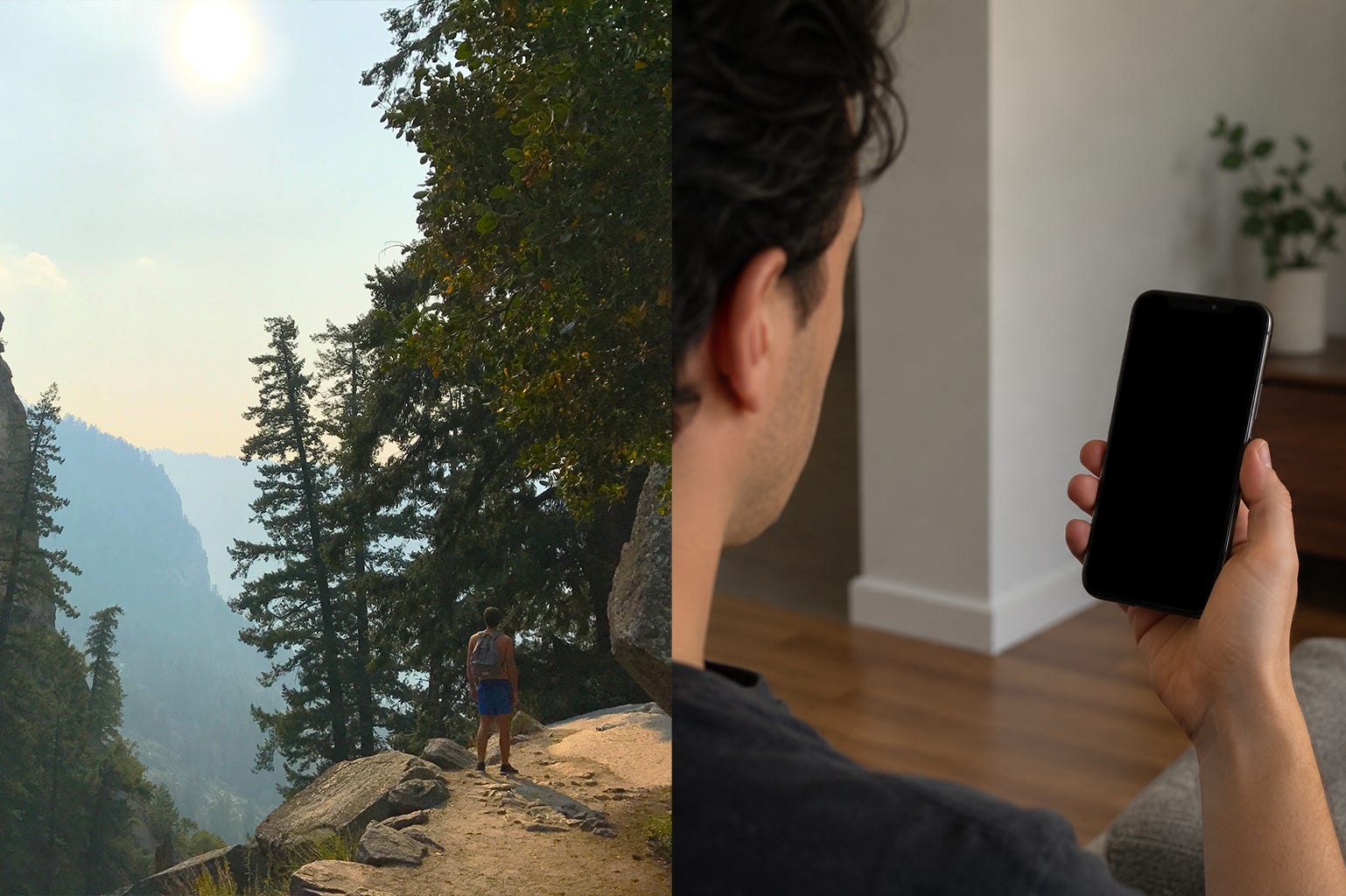
Meditation offers a clean way to taste the difference, and it does so with surprising humility. Sit and notice the breath, a sound in the room, a scene in front of you, and you begin to sense how experience is always arriving as one living field. Immersion in nature does this too. Step outside into an expansive panorama where sky, trees, birds and natural organisms are each doing their quiet work and the mind remembers that it belongs to something larger than its internal monologue. It is difficult to maintain the same tight, self-referential contraction when you are surrounded by the panorama of interdependent life, each part influencing every other part without needing to announce itself. By contrast, the small black screen of a laptop or smartphone can narrow attention into a tunnel, and it is no surprise that the ego loves that setting, because it is easier there to believe that the self is the centre and everything else is elsewhere. Notice what environments widen us into wholeness, and what environments compress us back into the narrow version of “me.”
When a thought arises, especially a self-thought, the subtle “I” that evaluates and narrates, see if you can notice it as a simple event. You do not have to argue with it, you do not have to believe it. Just watch the mind’s habit of claiming: “I am thinking,” “I am failing,” “I am becoming.” Then experiment with a gentler, non-dual language as a direct cue: it’s just happening. Thoughts are happening, sensations are happening, emotions are happening; I am not it, and it is not me. The most interesting part is that the seeing itself does not require an “I” at all; cause and effect can be understood directly. When the mind tightens around fear, the world narrows, when it softens into presence, life reveals more of itself, without needing a separate narrator to own the experience.
The purpose of the ego is to localise the vastness of your inner world and of life itself. It is the psychological skin that holds you together. It limits you, binds you to time, and subjects you to the rules of physical and social reality so that you can play the specific, messy, beautiful game of being a human being. However, identity comes to lean on assumption for a great deal of its existence. You are in the model of the moment, not the moment.
And language matters here more than we admit, because the words we use condition experience, shaping what we notice and what we ignore, what we allow and what we brace against. Beyond simply describing the experience with words, identity claims it; reaching into the flux of the present moment, grabbing a handful of sensations and meanings, and attempting to form a solid shape called “me,” and equally so one for “you.” And then, almost automatically, it begins to grasp onto that storyline. Grasping is attachment to a preferred story and aversion to whatever threatens it, which immediately breaks the possibility of felt wholeness. The ego does its job is to manage life, but when we come to be absorbedly wholeheartedly in it, we contract our selves and others down to a narrow band of experience.
It’s also no coincidence that suffering, trauma, and chronic stress tend to intensify this contraction. When a part of us viscerally senses it is fighting for survival, it becomes extraordinarily difficult to see and experience the wholeness of life; the nervous system prioritises threat scanning and control, and the ego’s protective strategies become louder and more convincing. Meanwhile, the path of healing runs in the opposite direction of effort: less control, and a gradual surrender of that inner bracing, a willingness to let awareness widen beyond the small perimeter of protection and into the greater expanse of the soul (and life), where experience can be held without immediately being turned into a threat to manage. This surrender isn’t a single dramatic letting go, and it isn’t a bypass of what hurts; it’s the slow re-learning of safety through presence. Of course, in the thick of that contracted state, even our most sincere attempts at presence can feel like trying to relax while bracing, because the body is not yet persuaded that it is safe enough to soften the boundary lines.
To release the contracted state, we invite ourselves to actively spend more time in the soul-space. To improve the will of the ego and effectiveness of persona numero uno, we spend more time actively engaging in disciplined tasks, holding limits and in social situations that challenge our capacity for discomfort.
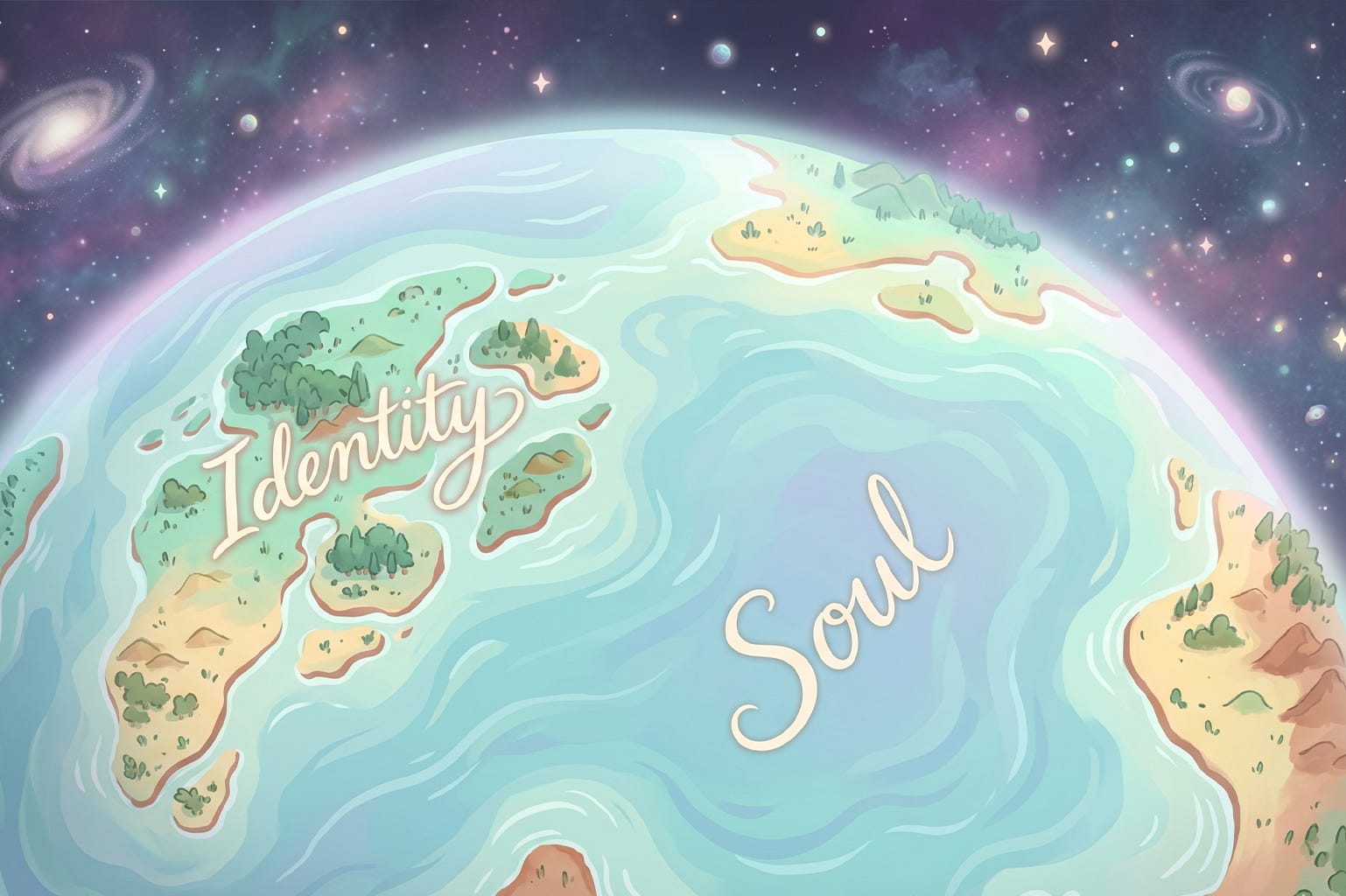
When the boundary of the ego softens, the contest of connection ceases to be a negotiation between personas and becomes a space of mutual completion. I begin to notice the ways you make me whole, by revealing the edges of myself I cannot see alone. And I find I can meet you where you are split, ashamed, or simply tired of pretending, entirely without the ego’s reflex to fix or manage you. There is a strange, tender reciprocity to it, almost musical: when you hit a peak, I often find myself in a trough, and I can hold steady while you rise; when I’m up high, you may be down below, and something in me naturally wants to pick you up, an instinct toward balance rather than a sense of obligation. While the ego-mind may look to extract concessions and assert power when the other is weak, soul asks for the path toward balance again and patiently invites the other to walk along it. Over time, if we are willing, we learn our harmonies, we learn the particular way our nervous systems dance together, and instead of constantly trying to rearrange the music, we begin to inhabit it, connected, distinct yet not separate.
This permeability extends far beyond intimate relationships. When we step out of the subject-object divide, that same soul-quality begins to illuminate our friendships, our passing interactions, and our relationship to the natural world. The strangers who cross our path are no longer treated as background extras in the movie of “me,” to be ignored or evaluated based on their rational utility. Instead, they arrive as synchronicities—catalysts for our growth, mirrors for our blind spots, and delicate threads waiting to be woven into the present moment. We walk through the public square, without a mind contracted into the safe, narrow tunnel of a smartphone screen, instead with eyes and nervous systems open to the strange, quiet intelligence of life meeting us exactly where we are.
Remember the two components of the brain we alluded to at the onset of this essay? The default mode network (ego-thinking) and the task positive network (present moment). Well, there’s a third, and this is where the aware way loves to reside. It is the salience network. Every time you realise your mind has wandered and you bring it back, it is the equivalent of a neurological miracle. You are strengthening the neural pathways that allow you to disengage from the ego's time-traveling, yet at the same time aware of the discipline the ego affords when necessary. The salience network fosters the flow state.
In those special flow states we experience effortlessly — when in love, when producing art just happens, when playing sport and it all clicks— the part of the brain that monitors your status and worries if you are "good enough" is literally deactivated. You stop doubting yourself and simply be. And because the ego is what tracks past and future, its deactivation means time dilates. That dinner date you had scheduled in between 7-8.30pm, ends up being five hours in what felt like twenty minutes, because the "timekeeper" is unplugged, and love is abundant. Over months of this kind of practice, the ego simply becomes less "sticky."
When a stressful thought arises during your day, with this practice in mind, you now have the neurological strength to shift away from what that means for personal numero uno, and back into the present moment.
The irony is that nothing mystical needs to be added for this way of life to become our default state of being. The ego can remain functional, while the deeper sense of self stops being trapped inside the persona numero uno’s constant self-preoccupation and negotiation. What we are really learning is fluidity: a mind that can move between its different functions without friction, using the ego and persona when structure, boundaries, and execution are needed, and yielding into soul when it’s time to listen, to feel, to connect, to receive, to flow. Incorporating both is wholeness, the full range of being human, where identity is neither denied nor worshipped, and where the world is less a stage and more a living field. When grasping relaxes, even briefly, what we call “me and you” begins to feel like a useful convention rather than the deepest fact, and something larger than either of our identities is allowed to move through the moment, making its quiet, integrating art out of ordinary life.
Great read, thanks