
Resting Postures
Humans evolved to move and rest. How often are you spending time resting in your natural postures?

Humans have been around for some time now. Not anywhere near as long as the universe itself, but we’ve been around for a few hundred thousand rotations of the Earth around its Sun. And in those 300,000 years or so, before ergonomic chairs and fancy spring and memory foam mattresses, our body organically evolved to exist in tune with its own self for its primary purposes. These would be movement, rest and the efficient storage and transfer of energy (i.e., blood, oxygen, nutrients). In this organic way, the human body learned how to sit, how to walk, how to breathe, how to lie down, in a manner conducive to the structure and biology of its own self. In this piece here, we are going to look at some of these foundational ways for sitting and resting that foster smooth energy flow, and support a healthy body.
Now, unlike the rigid, compressed, often unbalanced state induced while sitting on chairs and sofas, by engaging with these evolutionary movements and resting postures, we encourage a more fluid and dynamic relationship with our bodies.
It’s worthwhile reinforcing the point out that these foundational resting postures stem from the sequence that happens to and for every developing infant through the first year of their life (before modern life has time to interfere). They are the positions that our bodies naturally assume when given the space and opportunity to be itself.
By engaging in these foundational postures, we encourage our bodies to decompress and realign, promoting natural musculoskeletal health. A crucial aspect of the postures is the natural state of the spine. When we rest in flexed positions such as squatting or sitting cross-legged, the body can experience a gentle lengthening effect that supports spinal decompression. This contrasts sharply with the flexion and compression experienced in conventional sitting. In these natural postures, the spine can elongate, relieving pressure on intervertebral discs and promoting better overall spinal health. It’s important to note that these positions are not about being in them for hours on end. Rather, it is the postural integrity and transition they provide which creates the dynamic process the body asks for. Transitioning through them for a few minutes, several times a day, is plenty.
Sitting Cross-Legged
The most basic, and accessible, of our foundational resting postures is simply sitting cross-legged on the floor or sofa (or chair if you can manage it).
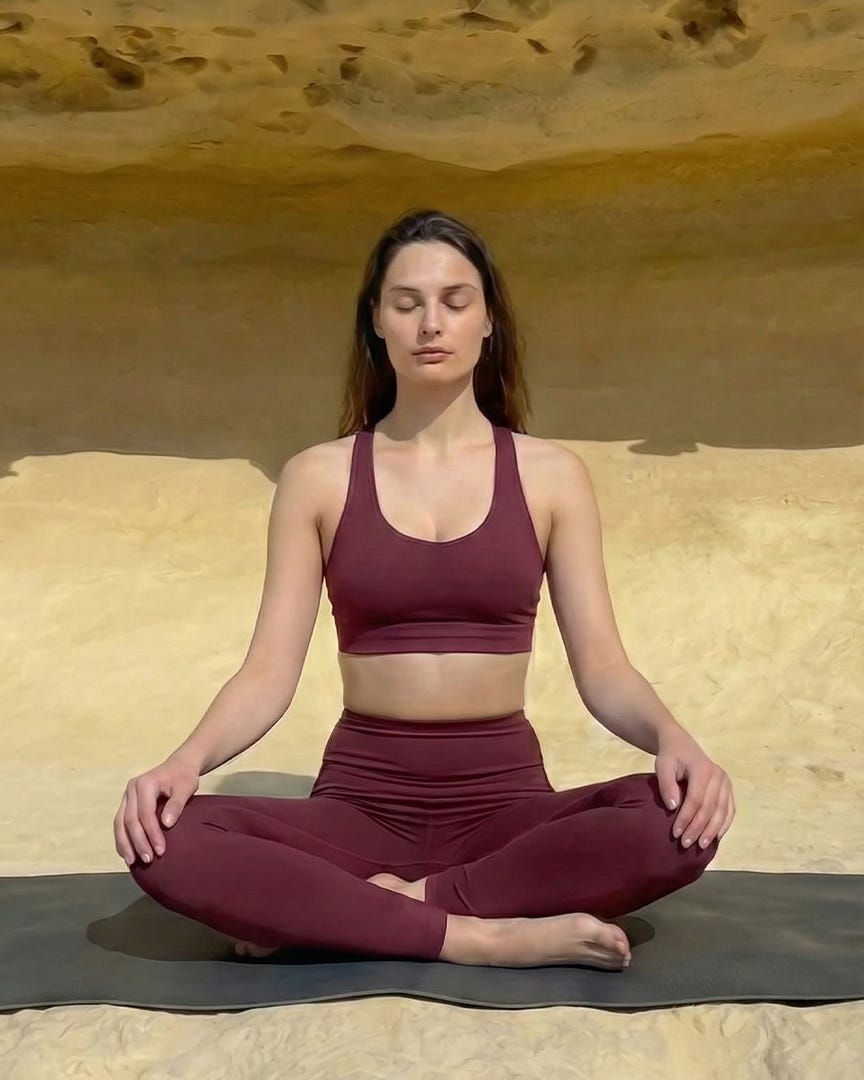
Now, it’s important that do the work early on, to ensure we rest in this posture the right way for it to turn into a positive feedback loop of bodily health, rather than a negative one. So here are a few cues and potential issues to be aware of:
If the breathing feels restricted, the posture is too rigid. Try to enter your body with the mind’s awareness, and gradually loosen it up wherever it may need loosening up.
Let the sit bones feel rooted and weighted, not tucked under, with the pelvis in a neutral to slightly anterior position allowing space of the spine to rise.
And while we would like a generally upright spine, invite the spine to self-organise over the pelvis with natural curves remaining present.
Finally, gradually allow the knees to descend below or toward hip level (with support if needed).
Of course, everyone has different levels of flexibility and motion in their joints. The majority of issues with this posture, if they occur, can be resolved by introducing a sitting object, like a cushion or blanket, underneath the pelvis to raise the hips.
Passive vs. Dynamic and Maintaining The Integrity of Transitions
Chairs are designed for comfort and convenience, not biomechanical health and rejuvenation. The foundational resting postures naturally spread load across tissues (helping prevent any one area from becoming overburdened while stimulating circulation, hydration, and resilience throughout the body) and hydrate the crucial fascial layer of the body. And as we’ve already mentioned, they also help to regulate and elongate the spine, integrating breathing and pelvic mechanics.
Chairs make the body passive as sitting on them tends to shorten the hip flexors, disengages the deep core, stacks the pelvis posteriorly, compresses the lower back and narrows breathing.
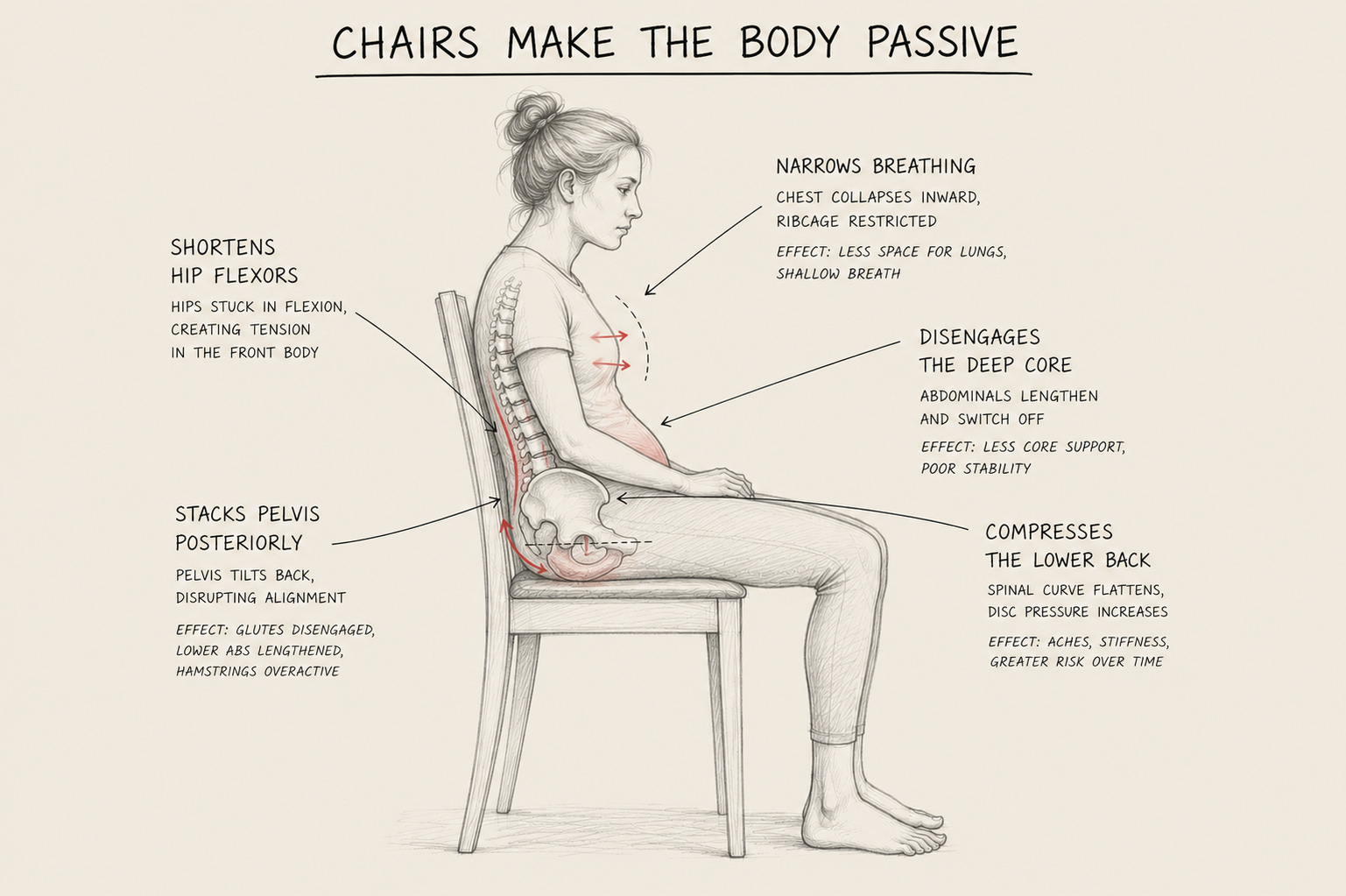
While the foundational resting postures usually require active hips, active feet, a long and neutral spine, balanced diaphragm (for breathing) and mobility transitions.
Chairs remove the crucial importance of transitions between postures. A simple movement from a floor or sofa posture to stand and back helps to maintain strength integrity in the body, preserving balance, keeping joints lubricated, stimulating fascia and retaining neurological patterning (the body’s learned movement pathways, such as these foundational postures). Chairs, quite frankly, attend to none of these. And as a result, promote, rather than prevent, age-related mobility loss.
Long Sitting
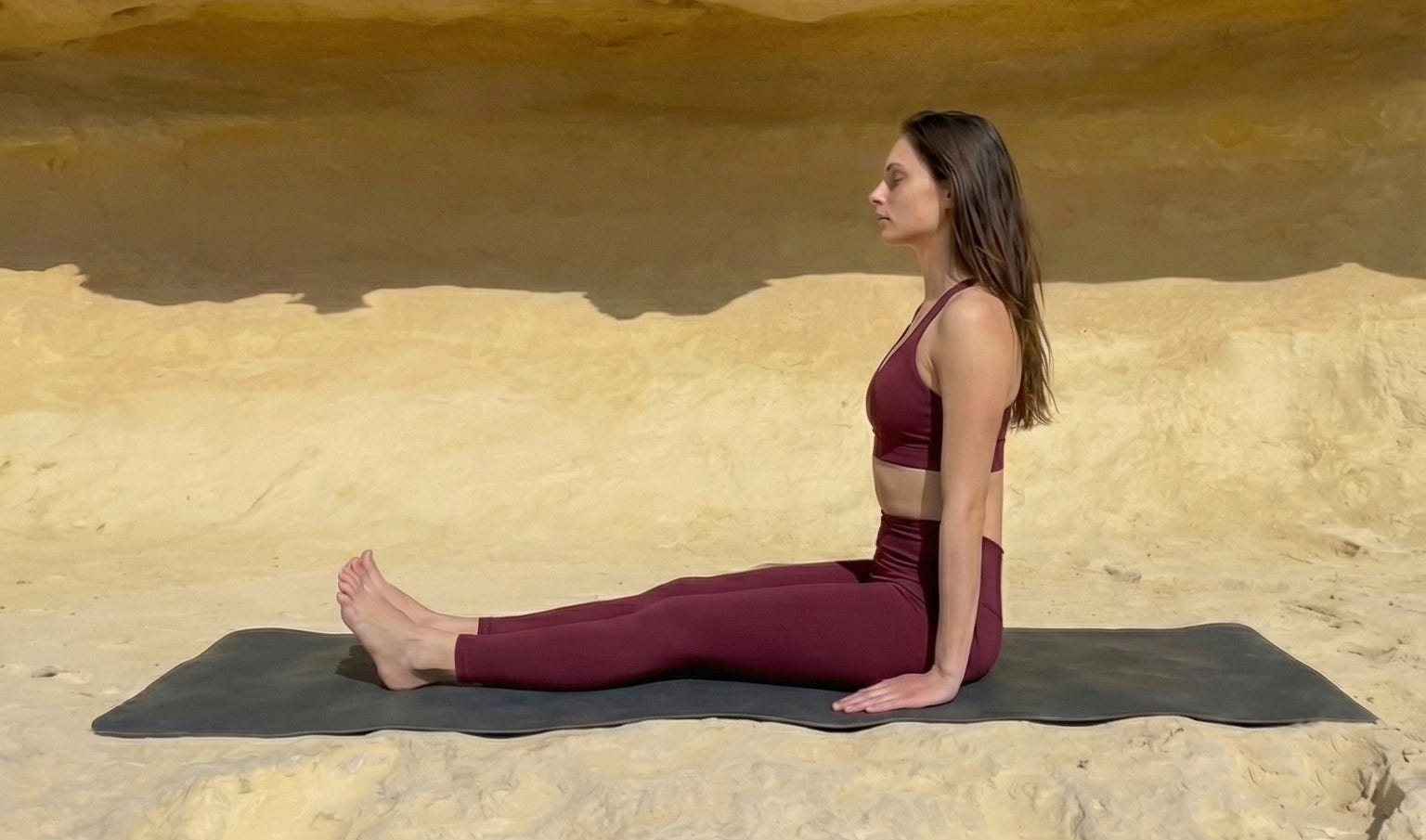
This is another foundational resting posture that can be easily accessed and reintroduces the body to upright sitting without hip flexion or knee folding. Biomechanically, it places the pelvis in a neutral or slightly anterior tilt (see drawing below), encouraging the spine to organise itself vertically rather than collapse (as in most chair sitting), while gently loading the hamstrings and posterior fascial line.
Unlike chair sitting, sitting upright on the floor requires active postural awareness and subtle muscular engagement, helping restore spinal length, improve proprioception, and rebalance habitual flexion from modern life. When practiced as a resting shape rather than a stretch, by spending several minutes in it with a quiet breath, sitting upright becomes a quiet tuning posture — one that supports transitions, encourages breath to move freely through the torso, and reminds the body how to sit tall.
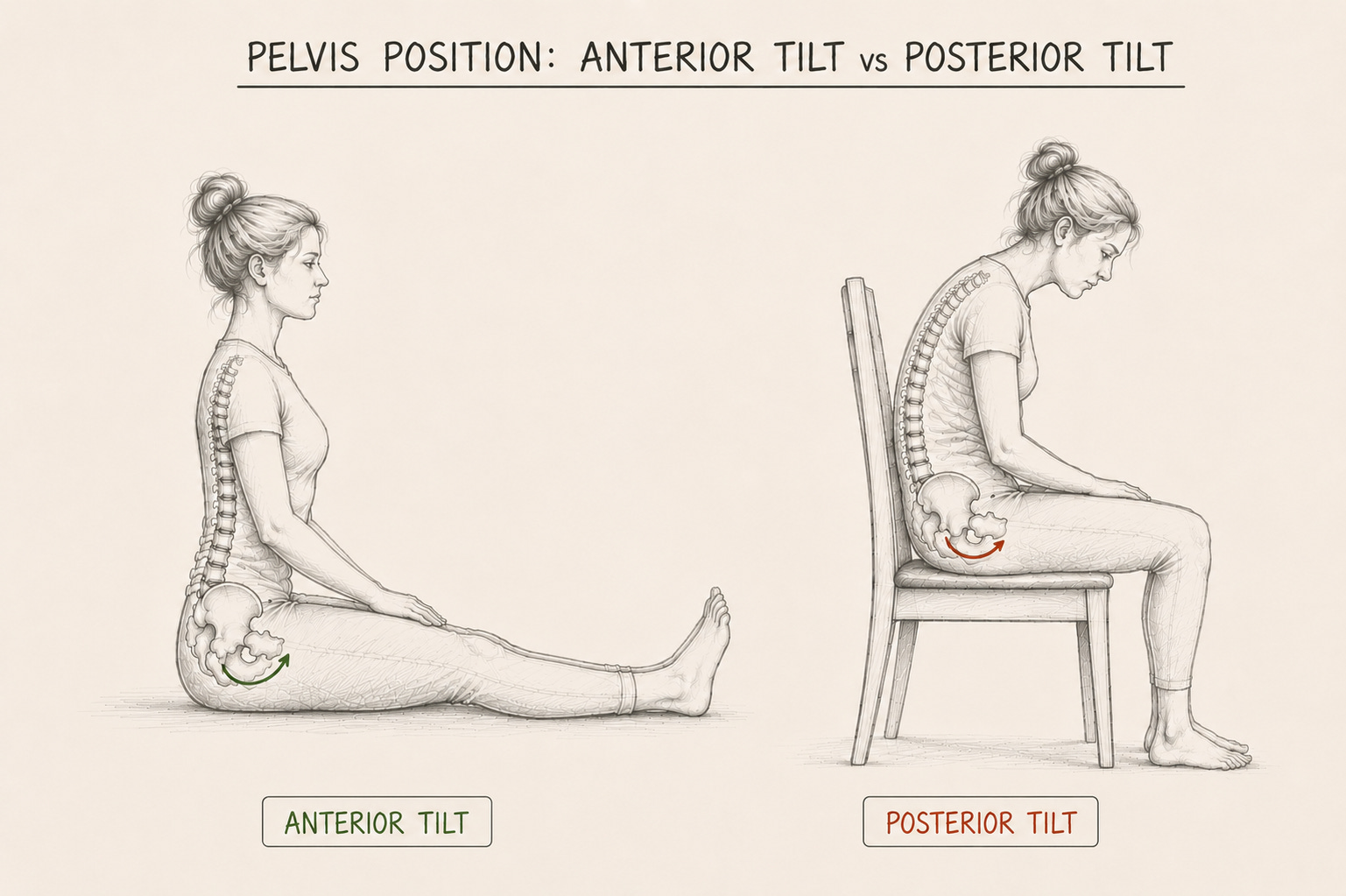
As with the cross legged posture, the cues to wholly experience this posture are similar:
A grounded pelvis and relaxed yet elongated spine.
Sit on the sit bones with the pelvis gently tipping forward, allow the spine to rise naturally without forcing uprightness.
Keep the legs relaxed rather than locked, with the feet soft and toes pointing upward.
If the lower back rounds or the chest collapses, it usually indicates tight hamstrings or sitting too low — elevate the hips on a cushion or briefly lean forward and rock back to find neutral.
Discomfort behind the knees often comes from over-straightening the legs; allow a micro-bend or place support under the knees. If effort accumulates in the neck or shoulders, soften the ribs and let the arms rest slightly behind or alongside the body. As with all of these postures, long sitting is best used briefly and revisited often, with transitions in and out preventing stiffness or strain.
Coming Back to Ourselves
As we introduce this new way of resting, and moving, into our lives, we must also move away from the manmade structures like chairs and sofas (at least some of the time), and come back to the solid ground of the earth. As we start to sit on the floor in these postures, postures that are our birthright, postures that our modern society neglects to value, we come back to ourselves.
We can start to incorporate rising from these foundational postures to our full upright bipedal posture to fully experience our deeply embedded patterns of movement. In a sense these resting postures are a way of toning, tuning and resetting our body using the patterns that we as humans have utilised for millennia. They are empowering in that they don’t require external practitioners to create positive change in the body. Everything happens in and of its own, by the simple manipulation of our own body. To stand up from the floor is a movement sequence we mastered as children. Regrettably, in our busy lives this mastery has lessened over time until the normal act of rising from the floor becomes awkward and uncomfortable.
Our musculoskeletal system needs the exercise of erecting to stay in good moving health. No matter the age, no matter the current conditioning of the body, everyone has the capacity to rediscover the natural structure and movement of their body.
It simply may ask of us a bit of practice and a changing of certain habitual patterns.
The body is actually a complex, interconnected system. Like any complex system, it has developed self-correcting mechanisms over time. When a system isn’t allowed to self-correct, problems arise. Individual elements become overused, and we see things like low back pain pop up like weeds. Complex systems crave variety. They actually thrive from a bit of manageable disorder. Changing up your habits and patterns can have huge benefits for the health of a system. For the human system, something as simple as sitting on the floor can be just the change we need.
All The Resting Postures


Notice the structural integrity of the body in each of these postures. The left and right hips are working in harmony, supporting balanced load and ease of movement. The spine is naturally elevated and organized, with the head resting above the pelvis (with the deep squat being the exception). When the pelvis makes contact with the ground, the body is deeply rooted. In these positions, the body is relaxed yet responsive — loose, but in control — allowing freedom of movement alongside a light, unforced breath.
These resting positions invite you to tap into the body’s natural ability to tune itself. The simple truth is this: if you want to move better, you need to rest better. And just like any instrument, the body needs to be tuned from time to time. Fortunately, it comes with a built-in tuner — or it did, before we decided to spend most of our waking lives in chairs.
Here are some further guidelines for these postures:
Be gradual and gentle in getting into them and out of them.
Breathe consciously and deeply throughout the movement/posture.
Be mindful of where the movement touches, accesses and stretches.
Be playful with allowing other movements (e.g. stretch your arms overhead in a squat)
Respect the experience of pain and recognising the edge of pain. Not forcing through but building tolerance to some mild discomfort.
Repeat them several times through the day (not as a chore but as if you were re-acquainting yourself with a long lost friend – kindly and respectfully).
I like this.
I really enjoyed this and it is very helpful, thank you 🙏❤️