

In 1309, Chinese medicine man Wu Rui was cited as writing “Shiitake improves qi (spirit, vital energy), doesn’t starve, cures cold and penetrates into the blood circulatory system”. The knowledge of modern science has largely confirmed Wu’s perceptive work on shiitake mushrooms. Beyond this, emperors of ancient China ate the mushroom in great quantities to “prolong the onset of old age”, considering it an elixir of life. It bodes well that something with the quality of being an invigorator of life and vital energy, shows pronounced immune-modulating, cancer-inhibiting and nervous system regulating effects in modern research and studies.
Renown for their umami taste, which translates in Japanese as “essence of delicious”, shiitake mushrooms have become one of the most cultivated foods on Earth. They are able to be home-grown by using spawn and old logs, while existing in the wild far and wide across underground mycelium networks that can stretch out for miles in diameter and live as a quiet architect of forests, decomposing wood, cycling nutrients, and building the invisible networks beneath our feet. Funghi truly are unique organisms to what we are accustomed to in our daily, above ground, conscious life.


Qualities
· Inward moving · Immune potentiating · Healing · Umami taste · Below ground · Calms the nervous system · Warming · Chewy and meaty ·
Character
The name Shiitake comes from the Japanese words shii (the type of oak tree they often grow on) and take (mushroom). While they are available fresh year-round due to modern indoor cultivation, their natural season leans toward the cool, moist transitions of spring and autumn. Historically, they were wild-harvested from the decaying wood of deciduous trees, playing the vital ecological role of saprotrophs—organisms that feed on and break down non-living organic matter.
Growing shiitake does require the cutting down of healthy trees, where the mushroom mycelium needs to grow. However, these trees are usually harvested as part of forest thinning or management, taking out poor-quality, crowded or suppressed trees to allow healthier ones to grow.
Once harvested, shiitake is eaten in a variety of ways. Fresh sautéed, simmered into soups and broths, or dried to intensify its flavour and shelf life. During the drying of dried shiitake, the mushroom’s cells break down and create a surge in 5′-guanylate, a key umami compound.
Rehydrating the Dried Shiitake
When using dried shiitake, the soaking liquid becomes a “dashi” or gold-standard stock. Never discard this water; it is rich in guanylate, an umami-providing compound that amplifies the taste of other ingredients it is cooked with.
The fresh caps tend to have a mellow, earth, springy feel, while dried caps bring a deeper aroma, and more concentrated umami. When soaked in liquid, they can become intensely savoury, and often form the soul of broths and stews. They are also available in extract form (powdered or liquid), as well as in the extract of certain active compounds of the mushroom (such as lentinan).
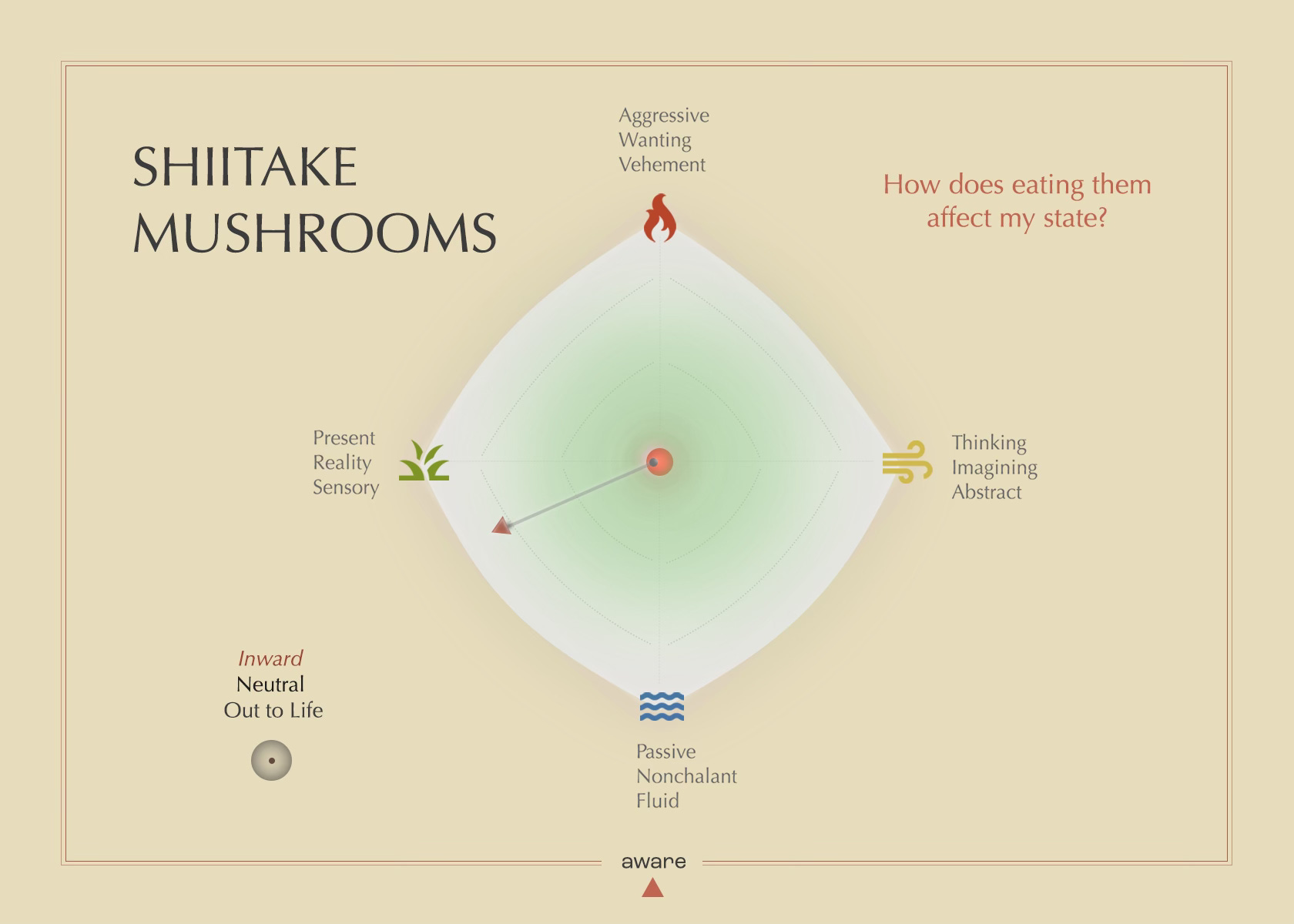
All these varieties of cultivating and cooking shiitake result in an assortment of character traits when we eat it. We’d like to hear about how you experience shiitake and its effects on your state in the comments below, though our suggestion is that overall it promotes a grounded, nourished state.
When we look at how this food influences the body, it is generally viewed as deeply restorative, calming, and grounding, associate with earth and wood. Unlike light, leafy greens that might feel cooling or cleansing, shiitake possesses a “heavy” and substantive quality that anchors the body. It is often described as having a sweet, neutral warmth — like the slow, building warmth of a hearty broth. This makes it particularly effective for those feeling “air-bound,” scattered, or physically depleted. In a society overwhelmed with stimulants like coffee, it can be a balancing blessing. It acts as a builder, replenishing deep energy reserves and nourishing the blood, rather than just providing a quick burst of fuel. When paired with warming aromatics like ginger, garlic or spring onion, shiitake becomes even more regenerating and easier to digest. However, because of this rich, building nature, it can sometimes feel too heavy or sluggish for those who already feel weighed down or lethargic.
We believe in a feeling approach to food. Paying whole-hearted attention to our current state of being. Paying attention to how each food affects our state of being after eating it. And asking ourselves — how do I want to feel? — as a barometer for what food to eat. Everything from how the food is prepared, to its taste, adjacent ingredients, and what part of the day and season it is eaten, as well as our own unique biology, influence this.
Nutrition Information
Shiitake mushrooms are a low-calorie food rich in fiber, B vitamins (particularly B5 and B6), and minerals like copper, selenium, and manganese. However, their true value seems to be in their bioactive compounds. Shiitake contains lentinan, a polysaccharide (beta-glucan) that has been studied extensively for its ability to activate the immune system.
Uniquely, shiitake mushrooms are one of the few non-animal sources of Vitamin D. They contain a precursor called ergosterol, which converts into Vitamin D2 when exposed to ultraviolet light. Placing your store-bought mushrooms in direct sunlight (gills up) for an hour before cooking can actually spike their Vitamin D content significantly.
Inflammatory Notes
While beneficial, Shiitake requires proper preparation. The cell walls of mushrooms are made of chitin, a tough substance (also found in crab shells) that humans cannot digest well. Cooking the mushroom breaks down this chitin, unlocking the nutrients and preventing digestive distress. Furthermore, there is a rare condition known as Shiitake Dermatitis, a whip-like skin rash caused by a reaction to lentinan, which usually occurs only when the mushrooms are eaten raw or undercooked. Finally, shiitake contains moderate levels of purines; while generally safe for most, those susceptible to gout or kidney stones should monitor their intake.
Scientific Research
The primary modern research around shiitake’s effects on human biology concentrates on immune function, gut microbiome modulation, cardiovascular health, and lentinan as an adjunct compound in cancer care research.
Immune health
A randomized dietary intervention in healthy adults found that daily consumption of dried shiitake improved immune markers (including increased salivary IgA) and shifted inflammatory signalling in a favourable direction.
(Dai et al., 2015) — https://pubmed.ncbi.nlm.nih.gov/25866155
Gut microbiome
A clinical trial in hypercholesterolemic adults evaluated a β-D-glucan-enriched extract from Lentinula edodes and reported modulation of the intestinal microbiota composition (with mixed/nuanced changes across other endpoints).
(Morales et al., 2021) — https://pubmed.ncbi.nlm.nih.gov/33580297
Cardiovascular health
Shiitake contains a compound called eritadenine, which has been shown to inhibit an enzyme involved in producing cholesterol. Studies suggest that consumption of shiitake can help lower serum cholesterol levels, supporting the ancient claim of it penetrating the blood circulatory system. (Yang et al., 2013) — https://tcr.amegroups.org/article/view/1136
Older human feeding studies (summarised in later scholarly reviews) suggest short interventions using fresh, dried, or UV-treated dried shiitake were associated with reductions in mean cholesterol in specific cohorts—an early “food as intervention” signal that likely relates to multiple compounds (including eritadenine) rather than one isolated mechanism.
(Breene, 1990; summarised in Lindequist et al., 2024) — Science Direct
Cancer adjunct
Individual patient-based meta-analysis work suggests adding lentinan to standard chemotherapy may offer a survival advantage in advanced gastric cancer settings (with the important framing: this is adjunct research using lentinan, not culinary shiitake as a standalone treatment).
(Oba et al., 2009) — https://pubmed.ncbi.nlm.nih.gov/19596954
Lentinan, the beta-glucan isolated from shiitake, has been used as an adjuvant therapy for cancer in Japan and China. This review highlights its mechanism of action, showing it does not kill cancer cells directly, but rather enhances the host's immune response to recognize and attack tumor cells. (Zhang et al., 2011) — https://pubmed.ncbi.nlm.nih.gov/21520446/
A more recent systematic review/meta-analysis similarly reports improved efficacy outcomes when injectable lentinan is combined with chemotherapy versus chemotherapy alone, while emphasising that additional high-quality RCTs are still needed.
(Wang et al., 2024) — https://pubmed.ncbi.nlm.nih.gov/38100922/
Nervous system regulation
Preclinical work has explored shiitake’s high ergothioneine content and potential neuroprotective/anti-senescence effects in neuronal cell models—promising as “directional science,” but best treated as emerging evidence rather than settled human outcome data.
(Apparoo et al., 2024) — https://pubmed.ncbi.nlm.nih.gov/38036238/
Vitamin D2 boosting
UV-B exposure substantially increases vitamin D2 concentration in shiitake (measured in different parts of the mushroom), supporting the logic of UV-treated mushrooms as a food-based D2 source.
(Ko et al., 2008) — https://pubmed.ncbi.nlm.nih.gov/18442245
Recipes
Sticky Sesame Shiitake Mushrooms

Mushrooms are a controversial food. You either love them or hate them. Personally I love them, they are one of my favorite things to eat. Especially shiitake mushrooms, yum. These sticky sesame shiitake mushrooms are perfect for a mushroom lover and can probably convert over a mushroom hater!