
Timeless Perspective on Investing in Anything
From shares in companies to the lives we build... Who reaps the majority of the reward?

To invest:
verb
gerund or present participle: investing
put (money) into financial schemes, shares, property, or a commercial venture with the expectation of achieving a profit.
devote (one's time, effort, or energy) to a particular undertaking with the expectation of a worthwhile result
In the early 1900s, a famed stock investor by the name of Jesse Livermore was the protagonist of a book, written by journalist Edwin Lefèvre, called Reminiscences of a Stock Operator. Even though it was published over 100 years ago in what were then the nascent early years of financial markets, the book is generally considered a bible of sorts for investors to this day because its lessons and virtues have stood the test of time. “There is nothing new in Wall Street,” asserts Livermore on the second page of the book, echoing the timeless expression by King Solomon about 5,000 years ago when, in the Book of Ecclesiastes, he wrote, “There is nothing new beneath the sun.”
Once we touch upon a fabric that seems to emerge from a timeless thread, its patterns and principles weave themselves into modern life. And when it comes to the investments we make in our lives, what makes one decide to commit the next decade of their life to living in a particular place? How come one marriage is abundant in togetherness, growth and health, even behind the curtain, while another is fraught with insecurity, resistance and a constant urge to separation?
As we grow, we all develop internal filters which attempt to determine a meaningful harmony between our positive inner needs and desires, and what the environment outside of us is capable and willing to offer. Yet, certain people seem to have access to these timeless threads, and they leverage them into successful major commitments they make through their lives. They don’t always get it right, but the good investments they do make, they grow into something bigger than themselves.
In Reminiscences of a Stock Operator, we bear witness to Livermore as he goes through both the pains of loss and jubilation of great successes. In the process, he evolves as an investor, and so does his capacity for reflection on what works sustainably and what is more or less whimsical. He is aptly searching for those timeless threads of good investing. One passage in the book illustrates particularly well one of the central challenges, maybe the central challenge, to good investing. Quoted below:
And right here let me say one thing: After spending many years in Wall Street and after making and losing millions of dollars I want to tell you this: It never was my thinking that made the big money for me. It always was my sitting.

Got that? My sitting tight!

It is no trick at all to be right on the market. You always find lots of early bulls in bull markets and early bears in bear markets. I've known many men who were right at exactly the right time, and began buying or selling stocks when prices were at the very level which should show the greatest profit. And their experience invariably matched mine-that is, they made no real money out of it.

Men who can both be right and sit tight are uncommon. I found it one of the hardest things to learn. But it is only after a stock operator has firmly grasped this that he can make big money. It is literally true that millions come easier to a trader after he knows how to trade than hundreds did in the days of his ignorance.

The reason is that a man may see straight and clearly and yet become impatient or doubtful when the market takes its time about doing as he figured it must do. That is why so many men in Wall Street, who are not at all in the sucker class, not even in the third grade, nevertheless lose money. The market does not beat them. They beat themselves, because though they have brains they cannot sit tight.

Old Turkey was dead right in doing and saying what he did. He had not only the courage of his convictions but the intelligent patience to sit tight
What Livermore is talking about here is that many people can be right on choosing a good stock, even if only by chance, yet it is exceedingly rare to find someone with the courage to make a meaningful investment and the patience and fortitude to stick with it. Once he learned this, the millions came easier than the hundreds did in his ignorance.
The value seems to come from letting a good trend accrue over time.
In the markets, we have to allocate the capital to the right place (ideally, at the right time) and let it work on its own over time. In life, we give our energy to the right endeavour and right people (in the right place), and guide the situation, with our presence, our thoughts and our actions, through troughs and peaks, forward over time.
Behind the curtain of such a simple, yet profound, idea, there’s a lot to unpack.
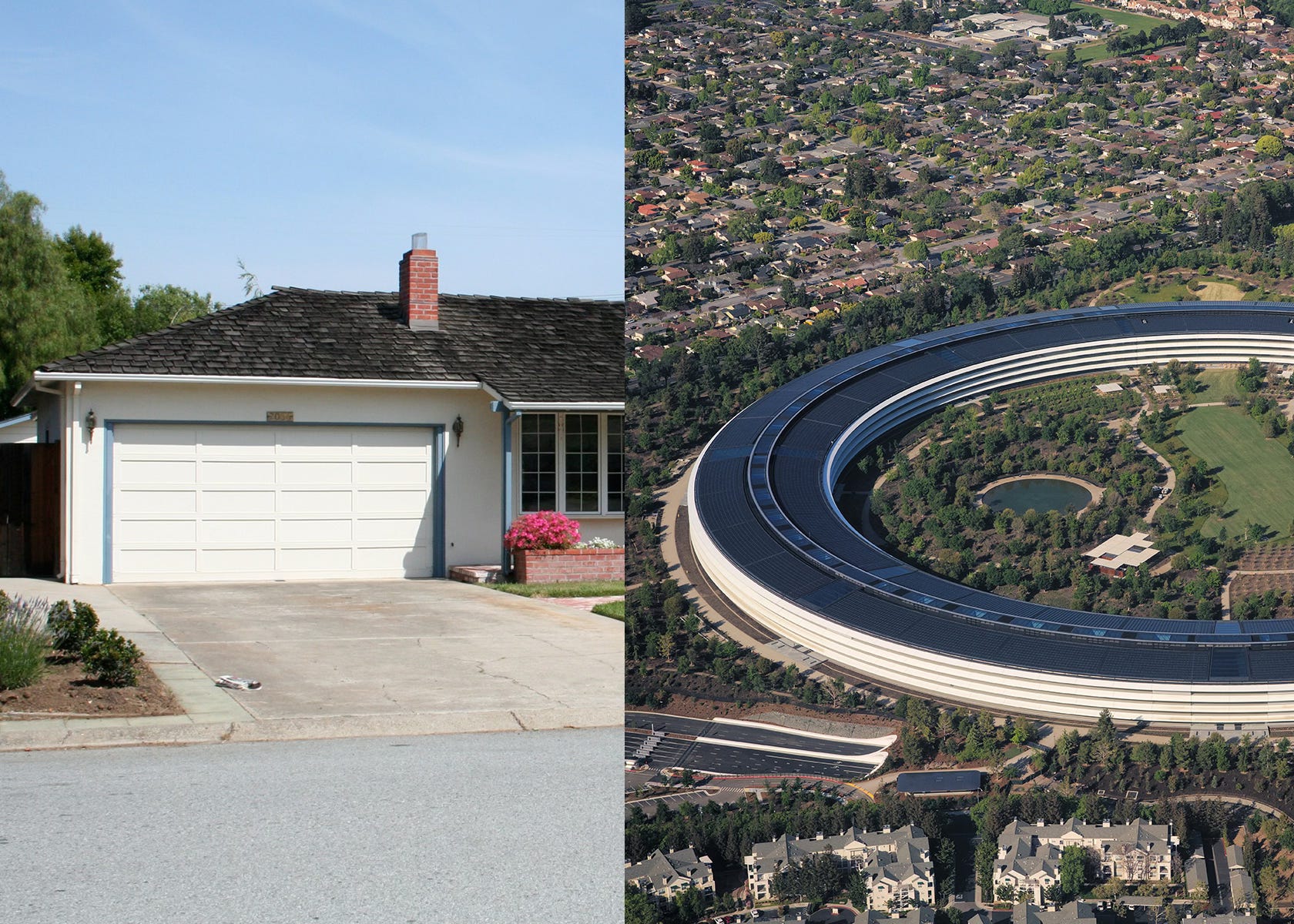
We all likely know about Apple today. Their computers, and then iPods, and then iPhones and iPads and iWatches, their perfectly designed boxes and clean white cables have found themselves in the homes and offices of many people in the developed world. It wasn’t always the case. Founded in 1976, infamously out of a garage in California, Apple was started by a child-like hippy, Steve Jobs, and a child-like geek, Steve Wozniak. Its first product was an assembled circuit board, without a keyboard or screen, and a plastic cover as optional - the Apple I.
Could anyone have envisioned what was to come next?

When Apple went public in 1980, just four years later, the founders became wealthy, very wealthy, and suddenly, anyone in the world could buy into their journey. If you had invested $1,000 in Apple on day one and simply sat tight, you’d have millions today.
But holding on is rarely that simple.
For the first seventeen years of its life as a public company, Apple’s stock went nowhere. By 1997, the price was exactly where it had started. Imagine holding those shares, likely with a passionately held belief in the company, its products, and its vision. Imagine watching competitors like Microsoft and Dell soar while your investment flatlined for nearly two decades. Steve Wozniak and Steve Jobs were gone. The company was teetering on the brink of collapse.
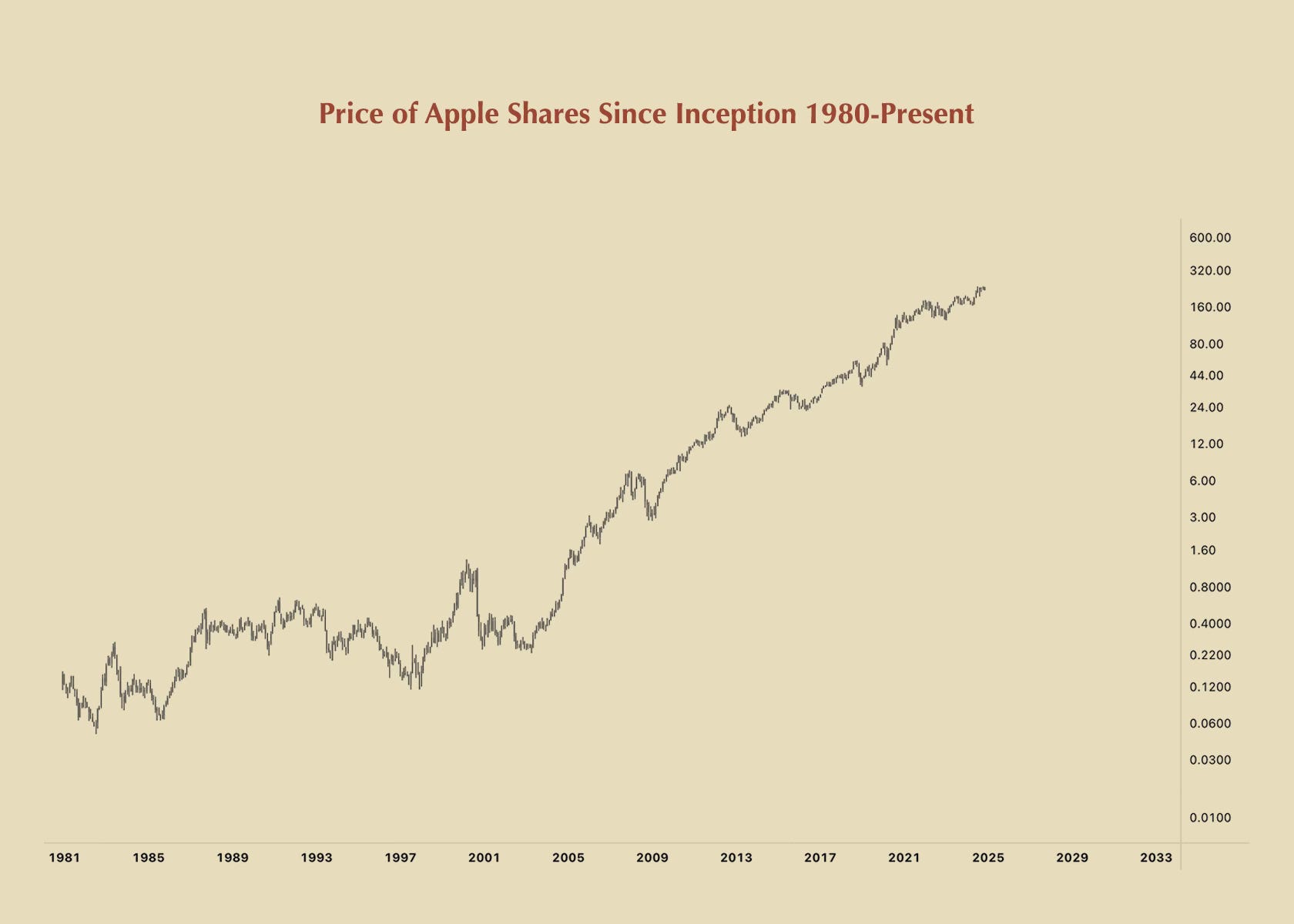
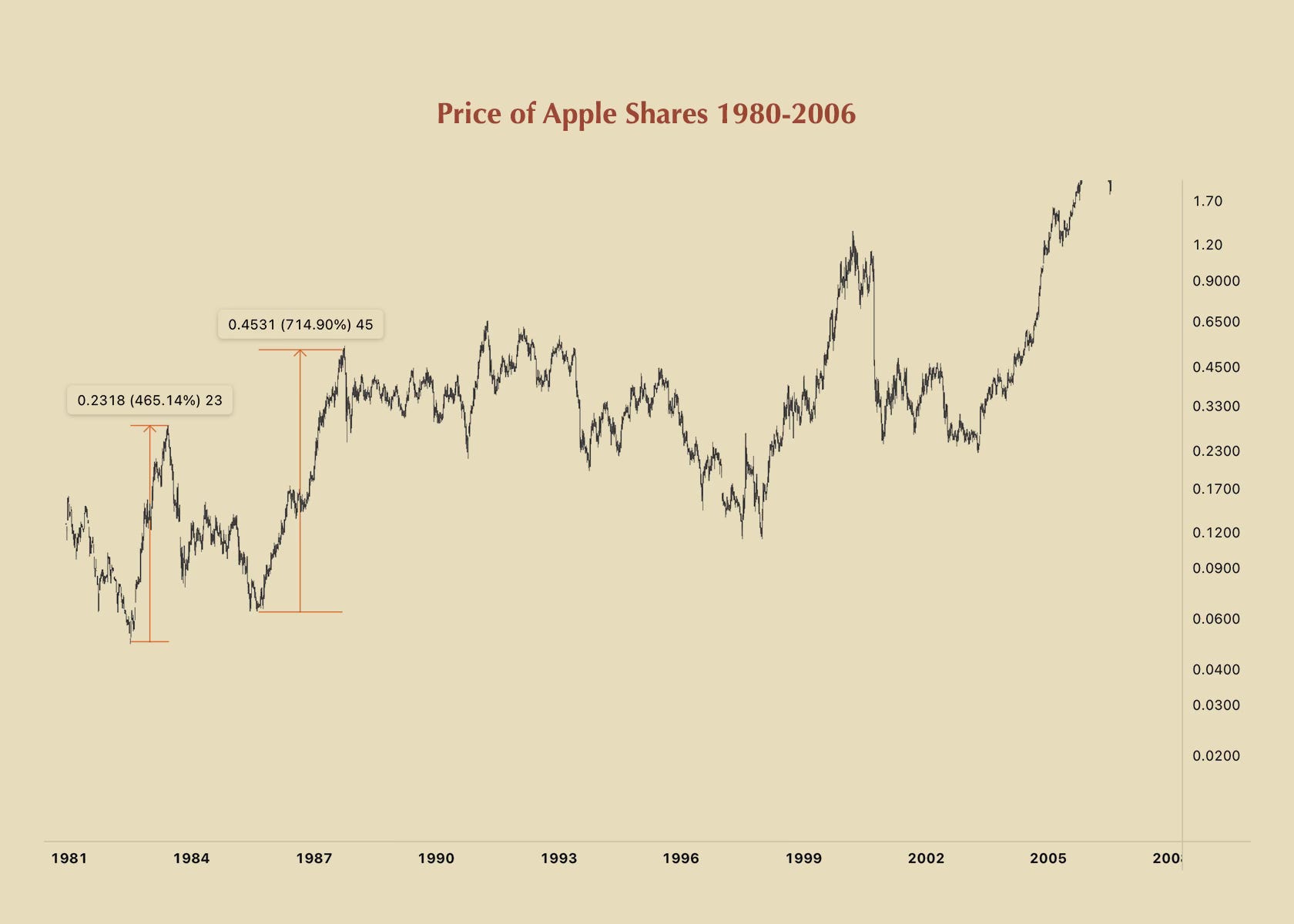
Even the greatest of things do take time to flourish. Apple is the most valuable company in the world today, yet for the first half of its life as a public business, the stock price went nowhere. The real growth of the share price began when the company appeared to be on the verge of collapse in 1997. This impending collapse also happened to prompt some meaningful reflection and the implementation of subsequent changes (i.e., re-hiring of Steve Jobs as CEO, a symbolic deal with longtime nemesis Microsoft, the slashing of much of its core product-line, and others), which would certainly have been wildly counterintuitive at the time, both viscerally and logically.
But why did it “suddenly” start to work so quickly and so well (the initial founding years from 1976-1980 where something bloomed out of nothing) and then why did it “suddenly” start working so quickly and so well, again, from 2003 onwards (when it became the first ever trillion-dollar company).
Character, Capability and Circumstance
If the secret to comedy is timing, the secret to timing is the right person, being in the right room of people, with the right tools in their back pocket. It ain’t always going to work, yet when it does, the splendour is splendid. And momentum has a lot to do with it, too — if someone just has that aura of being funny (usually because they’ve done it before), people will subconsciously incline toward laughing along. There’s also the reality that the right circumstances, meshing with strong personal capability can also paint over a subpar character, or a good character eventually can learn the right skills when placed in a conducive environment. But, in general, over a long enough time horizon, if the environment is right, a person with character and the right skills, who is working on something that is in demand, will move along well. The same tends to go for an investment in a business, for example. Good product, with good customer service, and being well marketing into an environment that’s conducive to it, will do well.
When it came to Apple, initially, it was a group of young enterprising guys who possessed the capability to create (Wozniak) and market (Jobs) a product whose time was “obviously” coming - the personal computer - into the wave of digital technology. What they lacked was the ability to manage a large group of people, which Apple quickly became. So the management board tried to bring in “adult supervision,” the integration of which slowly ruined the ethos of Apple. When Jobs’ character and capability had evolved enough over the ensuring 12 years, he came back, and eventually got the train back on the tracks covering a vast land that was still thirsting for new technology.
“The reason is that a man may see straight and clearly and yet become impatient or doubtful when the market takes its time about doing as he figured it must do.” Life is much like this, though, is it not? There will be false starts. There will be traps of exuberance - where we believe we’ve hit the jackpot - and daunting moments of exasperation - where nothing seems to work. Eventually, an opportunity will come along where the foundation is solid, so solid at the core, that even though there may be a myriad issues at the surface, soon enough the trend starts to tend upward.
“The market does not beat them. They beat themselves, because though they have brains they cannot sit tight.”Unfortunately, in many cases, after the experience of so many false starts and rollercoaster rides, our visceral response is to jump off the train far too early when we (finally) find the right one.
The Psychology of Self-Sabotage
On a deeper level, this is the internal war of self-sabotage. True growth requires us to expand. When we find ourselves on a path that demands profound personal evolution, we often resist, or we compensate. We subconsciously seek the familiar chaos of the rollercoaster over the quiet, sustained, holistic effort required to adapt to a better environment.
Worse, we lower our standards. We trade the challenging, high-upside opportunity such as a demanding partner, a rigorous career, a new city, for something flatter. We settle for something that demands less of us, something that just “kind of works.” We ground ourselves in the safety of the past at the expense of our future potential.
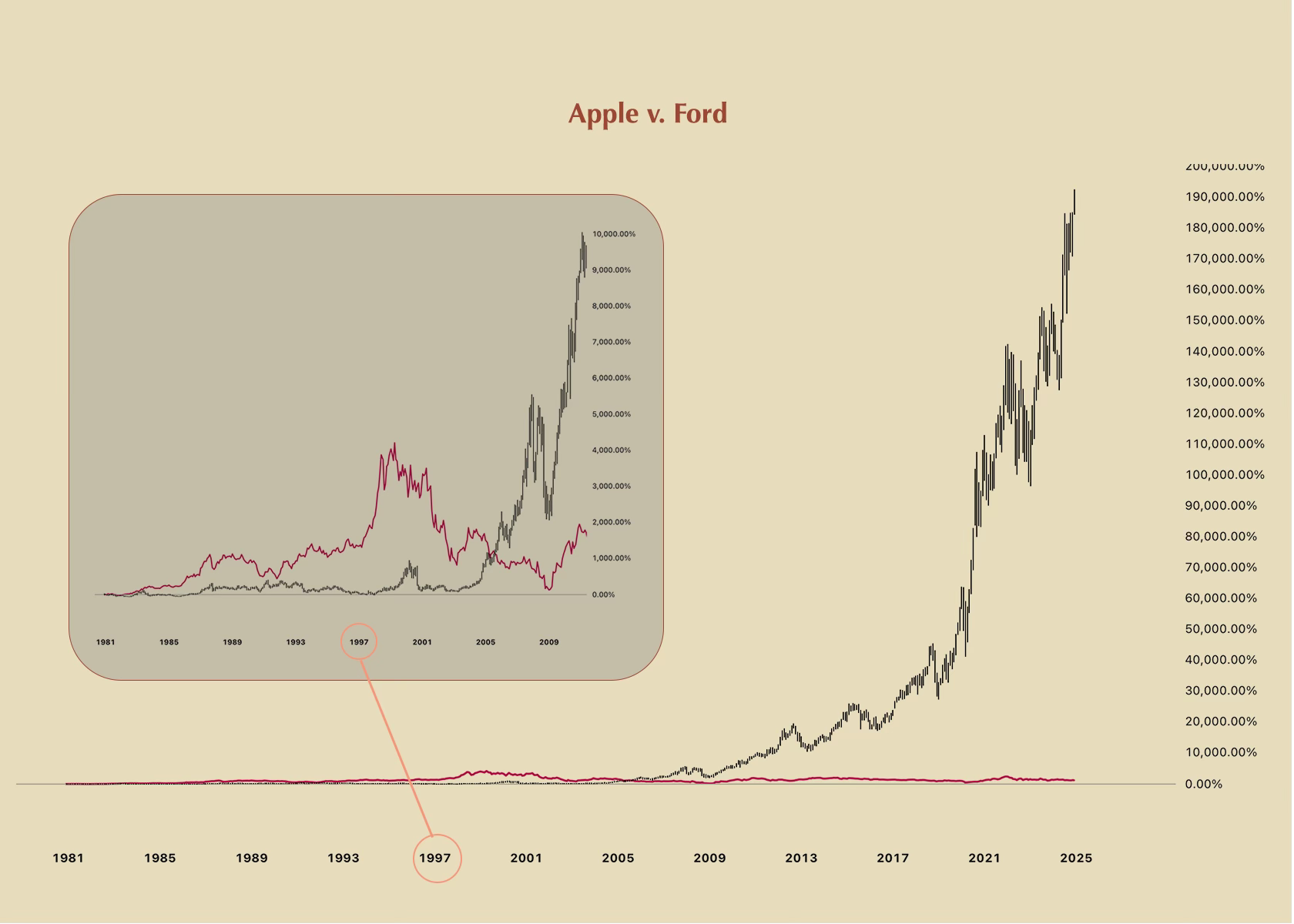
Take a look at a comparison of Apple (black) and Ford Motors (maroon) stock prices in the chart below. Ford was a generational company in the United States, until the new wave came along, and Apple was part of that new wave. Less understood, yet bursting with potential.
Finding The Core
So, how do we know when to sit tight? How do we distinguish the real deal from just another false start?
You cannot predict the future, and quite frankly, you really won’t know for sure. Life is non-linear and far too unpredictable on a consistent basis. You cannot map out a marriage or a vocation ten years in advance. But as you cultivate self-awareness and do the internal work, and as you pay close attention to life happening around you, without being swept away in trendy currents masked in marketing glitter, or your own inner ephemeral urges, you begin to recognise timeless threads. You learn to select for that rare harmony between your positive inner desires and what the external world is offering.
Because there are situations where we do have a feeling inside and our understanding of the outside world points to something with a strong foundational core to build upon. When these click, will you have the courage to commit, and stay committed? To sit tight.
“He had not only the courage of his convictions but the intelligent patience to sit tight.” The Apples of this world are exceptionally rare. Throughout a lifetime, you will only encounter a handful or two of people, places, or endeavours worthy of your deepest energy.
When you find them, commit wholeheartedly. As you move along that journey, the mind’s recency bias will quickly normalise the magic of the beginning, shifting your focus to the immediate frustrations of the present. You must actively fight this. You must remember why you started, nurturing the special foundation even when the exuberance fades. Those special reasons are at the core of what sustains whatever we have, and provided it is still in place, must be nurtured and given the light of day, and often.
Adapt Or Die
As time goes on, both our own inner world, as well as the environment outside of us, change. We evolve and so does the world around us. In this process, even the greatest of businesses, the greatest of individuals, the greatest of couples, are forced to run the gauntlet.
Ultimately, we all vote with our energy, whether consciously or unconsciously.
For the investor in a company, that means their money (money is energy in a social context). Once they have committed their capital to an investment, in most cases, there is nothing for them to do but sit. Sit, and monitor the foundation they originally invested in, as well as the current environment in which they operate. Are they still in alignment? If not, is the team or business actively working to bring them back into alignment, and how? These are the decisions the investor has to weigh, because if those fundamental conditions do change, then the only reasonable thing to do is to withdraw the capital. As Livermore put it:
“In a bull market your game is to buy and hold until you believe that the bull market is near its end. To do this you must study general conditions and not tips or special factors affecting individual stocks. Then get out of all your stocks; get out for keeps! You have to use your brains and your vision to do this; otherwise my advice would be as idiotic as to tell you to buy cheap and sell dear. One of the most helpful things that anybody can learn is to give up trying to catch the last eighth-or the first. These two are the most expensive eighths in the world.” We all vote with our energy.
For the individual and their life, that means their inner energy. What they do. What they think. How they invest each moment of every 24-hour day. Take for example one of the most important decisions we make in our lives: our life partner. When coming together, ideally, a healthy amount of those internal filters and external opportunities were in alignment. The other person was doing enough things that made you want to come closer and closer to them, and reciprocate by giving a substantial amount of your own energy. You start building a life, together. A shared home, together. Perhaps even children, definitely has to happen, together. Timeless threads are woven, and a beautiful garment starts to form. Then, four years along the journey, you begin to notice more and more that the things, the foundational things, that your partner was doing at the beginning, are just no longer happening anymore. “Well, I have so many other areas to focus on now,” they say. You’ve grown your lives individually and together, there are more complexities, more responsibilities. Gibberish. The complexities and responsibilities of a shared life are cited as the reason for the distance. Perhaps your partner sees something you can’t yet see about how you need to grow, individually and collectively, and that certainly ought to be embraced. Or perhaps the reality is a shift in values: other aspects have been prioritised over the internal core. Eventually, you may start to internally contemplate whether it’s time to move on. “To do this you must study general conditions and not tips or special factors affecting individual stocks. Then get out of all your stocks; get out for keeps! You have to use your brains and your vision to do this,” says Livermore. Here, you must look to your own heart and mind, rather than therapists and friends, and into the heart and mind of your partner. Am I willing to adapt to the new norm? Is that the evolution I want to engage in for the next however many years? Or, how engaged is my partner in adapting to my dissatisfaction at what we stopped nourishing, and bringing back that same core aliveness (perhaps in an altered form)? It’s easier to withdraw our capital from a company, than to separate from a long term partner. Separation is tough, the shared fabric you’ve woven together lives within you, unworn, and you literally have to start threading a new one, with someone else, from scratch. Yet, the process is much the same. Adapt or die. When the person, the company, the couple choose to adapt, to do the work, and to grow while keeping the core aligned, the reward is profound, because it fosters the power of “sitting tight.”
It is all much like a perfectly crafted, high-quality garment. The piece of clothing requires intentional care, but it will last you a lifetime. It is timeless, and somehow becomes more worn, yet better with time. Once you learn to tend to it properly, the urge to constantly look elsewhere fades. You simply wear it, and live.
This is a great reading and the principal of sitting tight can be applied to almost all aspects of our lives . Thank you 👏👏👏