
When The Hands Speak to The Mind
Fluid, free and aware fingers foster a fluid, free and aware mind.

How does the water feel young man? You don’t even know what spirit means yet, though I promise you that if you keep the same aliveness and awareness in your hands as you go through life, it will nourish your smile and spirit in the same miraculous way.
Spirit and hands is a unique connection to make, yet the human mind does it often and in abundance. The brain keeps a detailed living map of the hand. The fingers have a large, fine-grained territory in the sensory and motor brain because they are how we have touched, grasped, written, spoken, defended, counted, soothed, worked, and known the world for millions of years. Truly, the mind is not randomly above the rest of the body, doing its own thing, as it may appear to our eyes. It is built with body maps within, maps that reach out and communicate with the rest of the body through a deep network of nerves to feel the truth of things, and the map of the hand is the richest of all.
Have you ever found yourself lying in bed, lost in thought, only to “wake up” and find your hands pressed underneath your body, or squeezing onto something, or clenched into a fist?
When the mind is tense, and thought drives up tension, that map in the mind lights up into action. The hand grips and the fingers press harder and harder, as the body tries to hold itself. The tension is shared from the mind and into the hands, often without the person noticing it as it happens.
It is common for anxiety, reflection, stress, or vigilance to show up in the body: typically first as tension in the face; then as clenching, gripping or curling of the hands; as well as clenching in the jaw and tightness in the shoulders.
The way to work with that tension is to direct it into something useful or let it release through mindful presence.
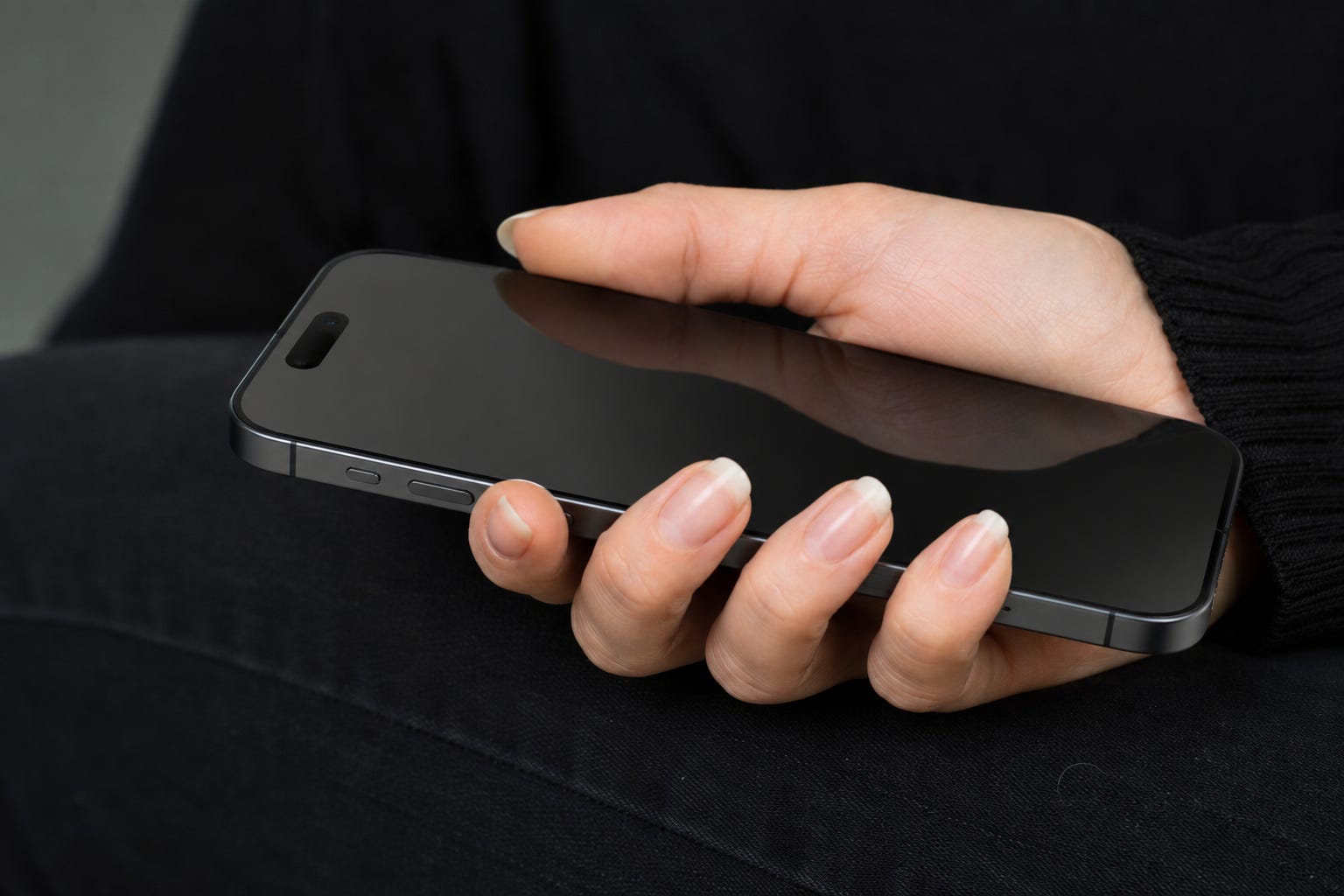
Unfortunately today, many people spend a meaningful portion of their day with their fingers tightly clenched around a glass smartphone. They aren’t necessarily in danger, yet the subtle position of the hand and the surface it is making contact with, are communicating to the mind a visceral image of threat.
The Body Map In the Mind
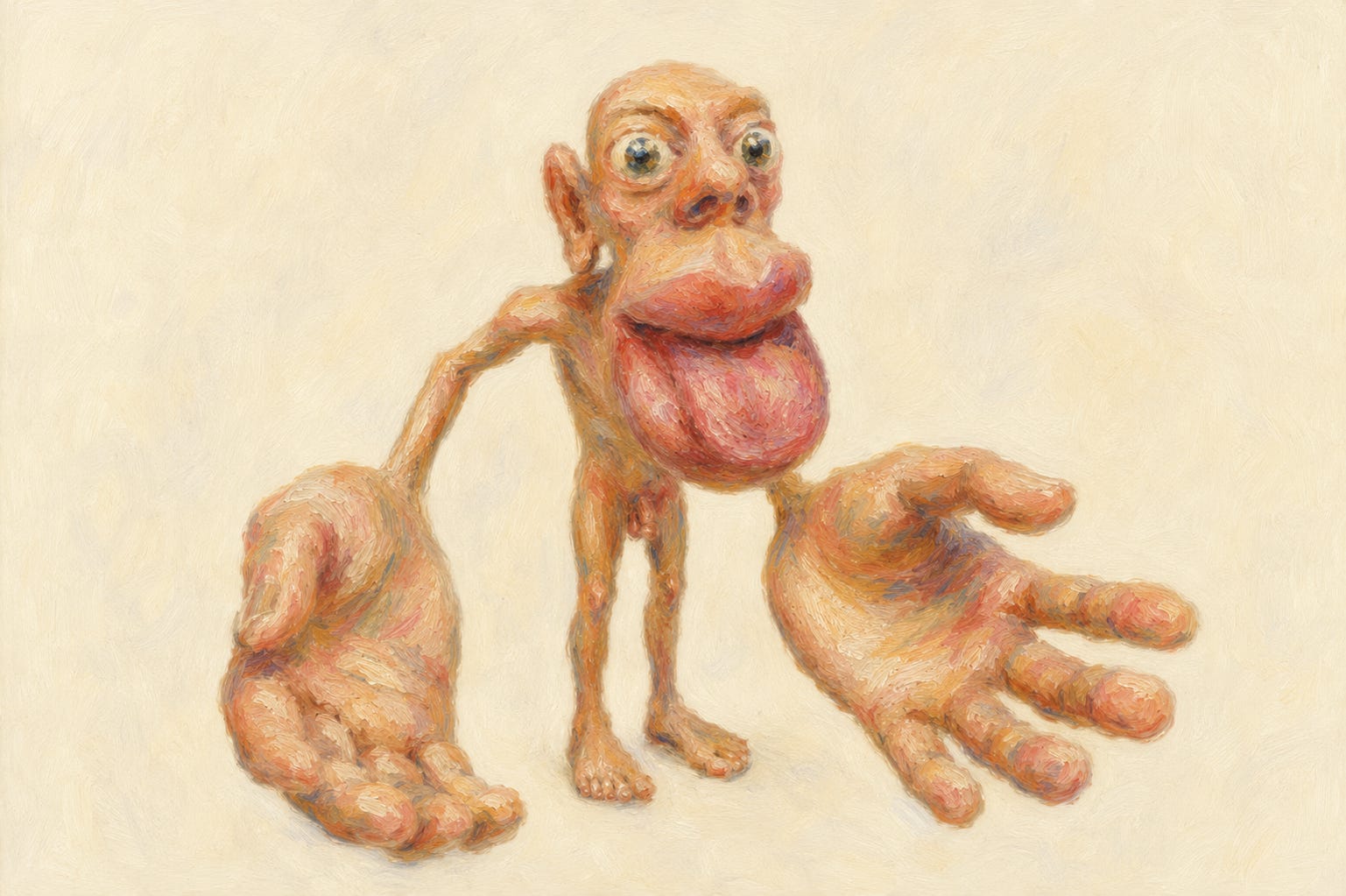
Scientists have come to call this map of what the brain pays attention to, the sensory and motor homunculus map. The space within this map basically determines how much brain territory is used to feel different body parts. In both the sensory (responsible for sensation) and motor (responsible for movement) components, the hands are huge.
If your brain were a late 19th, early 20th century Parisian painter, it just might decide to give you massive, oversized hands, like the image above. This would very accurately depict everyday life, inside the brain, where the area of the motor and sensory cortex dedicated to the fingers and palms is significantly larger than the area for the entire torso or legs.
The nervous system and the hands are intimately linked. Many, many people share anecdotes about going through stressful periods where they awake in the middle of the night to find their hands clenched tightly into fists. Sleep is the time your brain processes the emotions and memories of the day. If you are experiencing high anxiety, your sympathetic nervous system triggers a "fight or flight" response, flooding the body with stress hormones and causing the muscles to tense while you rest. Interestingly, studies show that clenching the fists is closely tied to sleep bruxism (grinding the teeth); both motions activate the same sensorimotor cortex in the brain during periods of high stress
At the extreme end, there is something called clenched fist syndrome. It is rare. It involves sustained flexion of the fingers, sometimes with contractures, and it has often been discussed in relation to psychiatric or psychological factors. The hand literally becomes a physical stage for distress.
By the way, this mechanism works both ways. Distressed, threatened mind→ tight, closed hands. Fluid, open hands → smooth, open mind. Practising how we use our hands in positive, intentional ways, over time, can lead to a beautiful reserve feedback loop in affecting our nervous system by harnessing conscious choice with our body.
The Evolution of Communication
Our hands are doing cognitive work.
Speech shows what we are ready to say. Gesture often shows what we are thinking before we can say it. And gestures do not merely express thoughts we have already formed in words; they can help form those thoughts. They can reveal ideas we have not yet verbalized, reduce mental load, help us learn, and give others insight into our thinking.
When researchers observe our closest relatives, chimpanzees and bonobos, they notice a stark difference between how they use their voices and how they use their hands. A chimp’s vocal cries (like a danger alarm or a food bark) are largely involuntary and hardwired. They are triggered by immediate emotional states. Their hand gestures, however, are highly deliberate. A chimp will use the same gesture for different purposes depending on the context, or use different gestures to achieve the same goal. They check to see if the other chimp is looking before they gesture. This intentionality is the bedrock of true language, suggesting our ancestors communicated complex thoughts with their hands millions of years before their vocal cords evolved enough to handle complex speech.
A key region in the human brain responsible for speech production is called Broca’s Area. But evolution didn’t build it from scratch; it repurposed an older area. In monkeys, the exact homologous brain region is responsible for controlling the hands and face.
Even though vocal language has became dominant, the nervous system never forgot its roots. That is why we still “talk with our hands” today, especially when struggling to explain a complex spatial concept or when emotions run high.
Take a look at this video of a man’s hand gestures as he speaks. Contrast this immersive communication experience, weaving together face, mouth, hands, body and speech, with reading texts and emails on a 6.3 inch glass screen. One is void, emotionless, robot-like. The other seems… human? What we do is who we become.
Danger… Self-Created
The modern hand is curled tightly around a piece of cold glass, for hours on end each and every day. The fingers are gripping, often hard. The tendons are locked. And meanwhile, the nervous system is an old, honest organism. It does not know what a screen is, or what an email means. It only knows the physical shape of the body. It feels these locked joints. It feels the clenched, curled fist of a person bracing for an attack, and it stays on edge. The phone is a phantom predator, and the hand tells the brain to be afraid. The danger is self-created, but the exhaustion is real.
Many people describe a mental fog that comes from swiping on glass (low-tactile input) versus the clarity of working with wood or yarn in our hands. Swiping at glass offers no resistance, no texture, no truth. It is an empty motion. The mind spins out of control because the hands are starved for something real to hold. This aligns with the recent realisation that digital hyper-connectivity can lead to anxiety and burnout, while manual engagement with the hands offers a rhythmic, nervous system balance1.
Coming back to our homunculus man, and that vast, intricate body map within our brains. Put a man inside the magnetic tube of an fMRI scanner2. Tell him to hold completely still, and then lightly brush the tip of his index finger. Beneath the surface of a single fingertip, there are thousands of tightly packed nerve endings. They are not all the same. Some are built for deep pressure. Some are built for the slip of a wet rope. And some are so impossibly sensitive they can feel a ridge in the wood thirteen nanometers high3.
A hand can read the world at a microscopic level. That is wild if you sit with it. In older adults, hand dexterity (the ability to perform fine motor tasks) is a “robust, independent predictor” of global cognitive health. When the hands lose their “edge,” the mind often follows4. How we use our hands, matters a great deal to nourishing our minds and overall state of being.
From Hand to Mind
So, what can we do about all of this? Stress is still going to arise. We’re going to be tense. Trauma, in some form, tends to happen to everyone at certain points in their lives. The modern demand of using a smartphone to communicate and conduct various tasks isn’t going away. The hands will, inevitably, want to tighten, contract and become confused at the lack of tactility (glass screens, plastic keyboards) in modern life.
There’s a lot we can do, and it was starts with being aware of our hands, making positive choices, and returning our awareness back to our hands throughout our day. In the process, we can repeatedly return our hands back to these two postures.
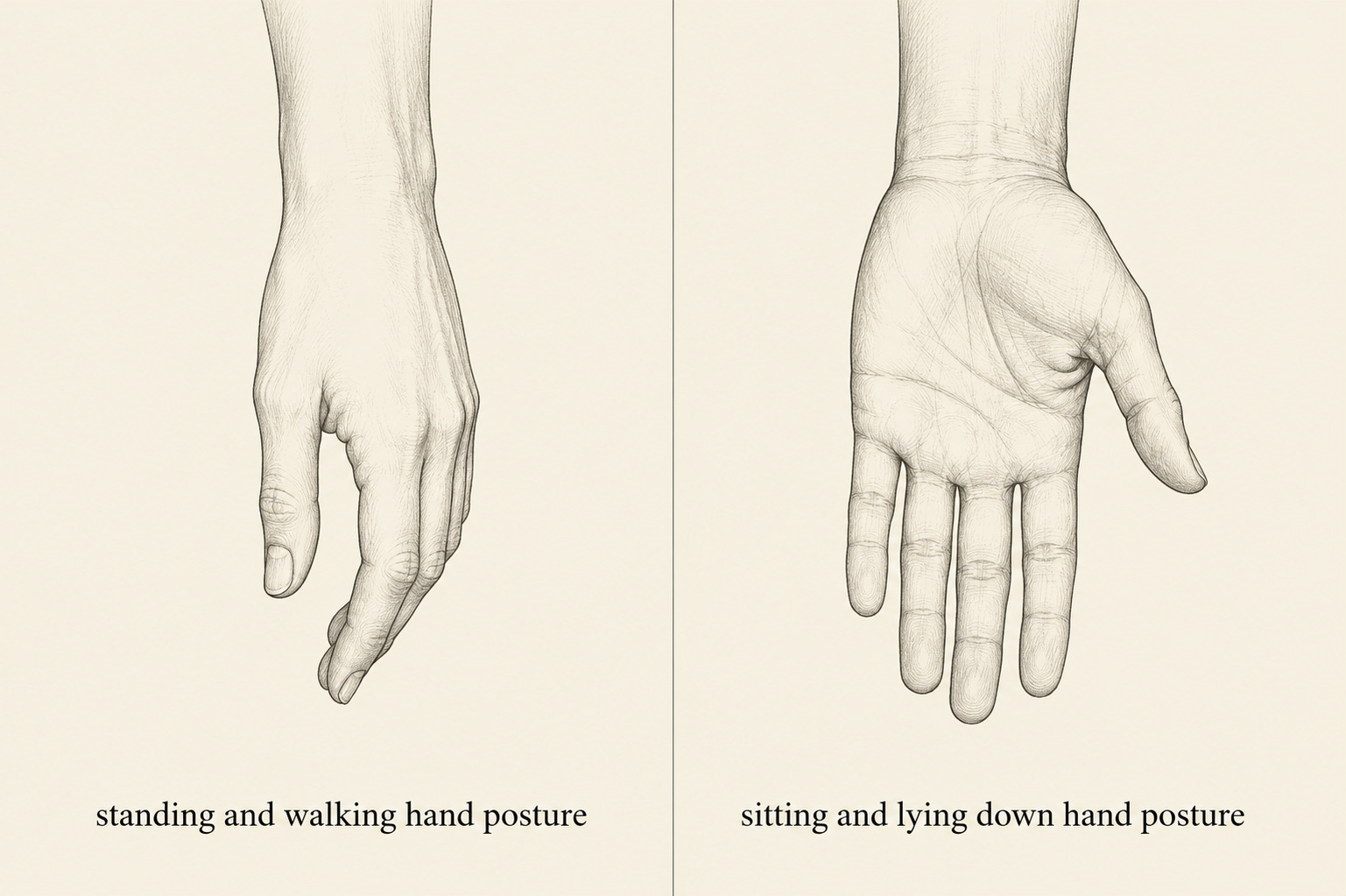
The standing and walking posture is a relaxed hand, with a natural, gravity inducing slight bend of the fingers. The sitting and lying down posture is open, long and intentional.
When the hand softens, the brain receives a different pattern. The hand no longer holds the signal to prepare for action, ready to ward off threat. We soften the signal, intentionally. Opening the hand may not erase grief or panic. However, it may remove one source of bodily confirmation that something is wrong, and begin to form a new imprint in the mind about the past. In this way, we also soften our view of the world as a battleground, and become open to new experience and heightened awareness to daily life.
The next step is to start using the whole dynamic beauty of the human hand in fluid, natural ways.
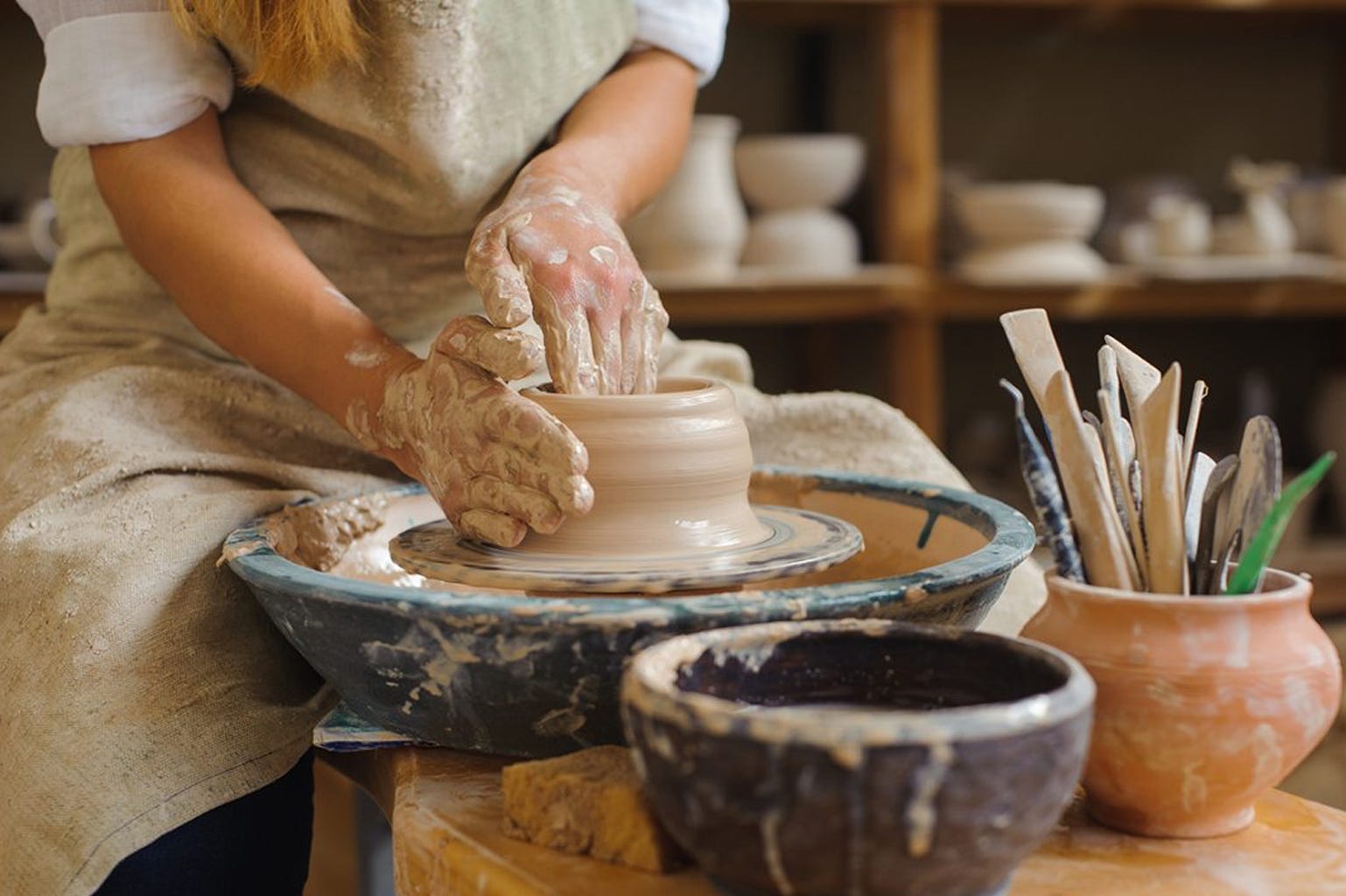
Take up hobbies that organically foster the hand getting messy and intimate, through touch, sensation, and interaction with raw organic materials. Play with the hands in the sea. Move sand around. Touch your (human) partner, often, delicately, firmly, long strokes, soft touches, everywhere all at once. The piano is a beautiful way for the hands to move in harmony with the mind, and we don’t all have to be Carnegie Hall concert pianists to enjoy it.
And when it comes to the smartphone. Are you able to switch what you read on your little device, to a tablet, laptop or even in paper form? Can you foster a way of holding the phone, when you have to hold it, in a detached, relaxed and distant manner?
This is all about the human touch, and how well we nourish it in the context of the demands of modern life. When the hands speak to the mind, let the voice be one of smooth, fluid and present awareness.
Giancola, M., et al. (2025). Don’t touch my smartphone! The psychological and sensory-motivational factors of problematic smartphone and social media use in emerging adulthood. Frontiers in Developmental. https://www.frontiersin.org/journals/developmental-psychology/articles/10.3389/fdpys.2025.1617529/full
Sanchez-Panchuelo, R. M., Francis, S., Bowtell, R., & Schluppeck, D. (2010). Mapping human somatosensory cortex in individual subjects with 7T functional MRI. Journal of Neurophysiology, 103(5), 2544–2556. https://pubmed.ncbi.nlm.nih.gov/20164393
Skedung, L., Arvidsson, M., Chung, J. Y., et al. (2013). Feeling Small: Exploring the Tactile Perception Limits. Scientific Reports, 3, 2617 https://www.sciencedaily.com/releases/2013/09/130916110853.htm
Schneider, T. R., Felbecker, A., von Mitzlaff, B., Weissofner, G., Meier, S., Eggenberger, P., & Annaheim, S. (2025).Hand dexterity and mobility independently predict cognition in older adults: a multi-domain regression analysis. Frontiers in Aging Neuroscience, 17. https://doi.org/10.3389/fnagi.2025.1234567
This is an enlightening read, thank you
Thank you, very helpful ❤️